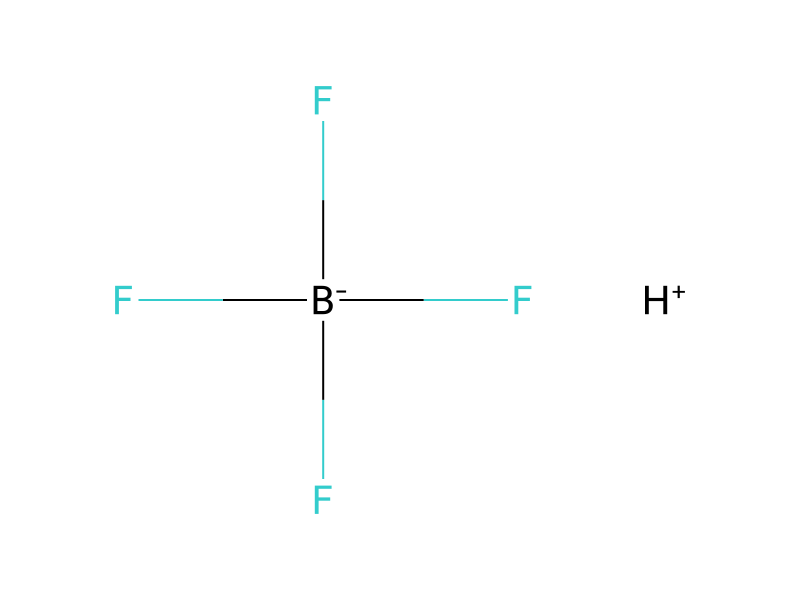
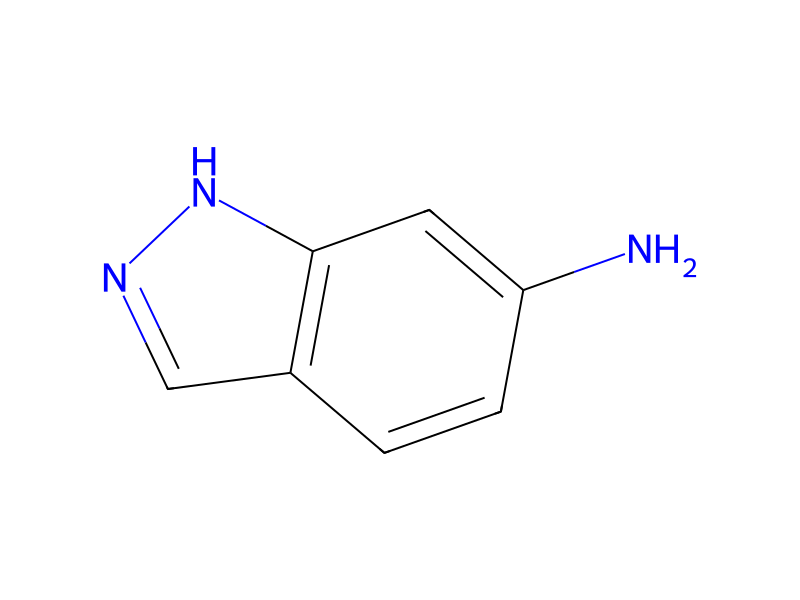
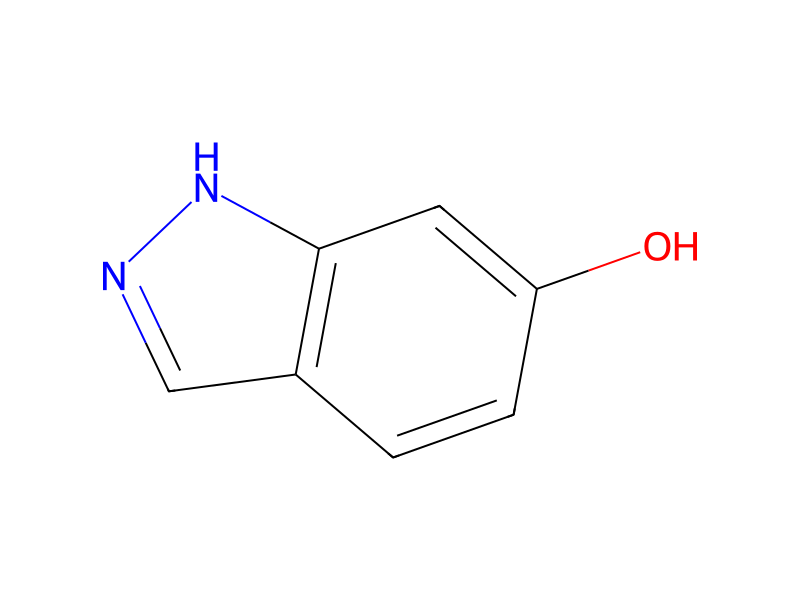
Tetrafluoroboric acid → 6-hydroxy-1H-indazole
Reaction equation

[NH:1]1[C:9]2[C:4](=[CH:5][CH:6]=[C:7](N)[CH:8]=2)[CH:3]=[N:2]1.F[B-](F)(F)F.[H+].N([O-])=[O:18].[Na+]>O>[NH:1]1[C:9]2[C:4](=[CH:5][CH:6]=[C:7]([OH:18])[CH:8]=2)[CH:3]=[N:2]1Participants
Reactant 3

Product 1
Reagents, catalysts & solvents 1

Conditions
- Temperature
- 0 °C
Procedure
Indazol-6-amine (24.33 g; manufactured by Tokyo Chemical Industry Co., Ltd.) was dissolved in water (100 mL) and a 48 wt % aqueous solution of tetrafluoroboric acid (242 mL; manufactured by Sigma-Aldrich Co.), and the solution was cooled to 0° C. Subsequently, an aqueous solution of sodium nitrite (20 mL (sodium nitrite (13.87 g; manufactured by Kanto Chemical Co., Inc.) was dissolved in water (20 mL)) was added dropwise to the solution over 10 minutes, and the resulting mixture was stirred for 30 minutes at 0° C. Precipitates of the reaction solution were filtered, and were washed with chloroform. The obtained precipitates were dissolved in acetic acid (250 mL), and the solution was stirred for 10 minutes at 50° C., for 10 minutes at 110° C., and for 10 minutes at 130° C. The reaction solution was cooled, a saturated aqueous solution of sodium carbonate was added thereto, and the mixture was extracted with ethyl acetate. The organic layer was washed with brine, and was dried over anhydrous magnesium sulfate. The solvent was evaporated under reduced pressure, and the resulting residue was dissolved in ethanol (240 mL). A 2 mol/L aqueous solution of sodium hydroxide (365 mL) was added to the solution, and the mixture was stirred for one hour at room temperature. The reaction solution was concentrated under reduced pressure, and 2 mol/L hydrochloric acid (200 mL), water and a saturated aqueous solution of ammonium chloride were added to the residue to adjust the pH to about 7. The mixture was then extracted with ethyl acetate. The organic layer was washed with brine, and was dried over anhydrous magnesium sulfate. Subsequently, the solvent was evaporated under reduced pressure, and chloroform was added to the residue. Insoluble matters were filtered, and were washed with chloroform. Thus, a crude product (13.5401 g) of the title compound was obtained.
Workup
- additionwas added dropwise to the solution over 10 minutes
- customPrecipitates of the reaction solution
- filtrationwere filtered
- washwere washed with chloroform
- customThe obtained precipitates
- dissolutionwere dissolved in acetic acid (250 mL)
- stirringthe solution was stirred for 10 minutes at 50° C., for 10 minutes at 110° C.
- waitfor 10 minutes at 130° C
- temperatureThe reaction solution was cooled
- additiona saturated aqueous solution of sodium carbonate was added
- extractionthe mixture was extracted with ethyl acetate
- washThe organic layer was washed with brine
- dry with materialwas dried over anhydrous magnesium sulfate
- customThe solvent was evaporated under reduced pressure
- dissolutionthe resulting residue was dissolved in ethanol (240 mL)
- additionA 2 mol/L aqueous solution of sodium hydroxide (365 mL) was added to the solution
- stirringthe mixture was stirred for one hour at room temperature
- concentrationThe reaction solution was concentrated under reduced pressure, and 2 mol/L hydrochloric acid (200 mL), water
- additiona saturated aqueous solution of ammonium chloride were added to the residue
- extractionThe mixture was then extracted with ethyl acetate
- washThe organic layer was washed with brine
- dry with materialwas dried over anhydrous magnesium sulfate
- customSubsequently, the solvent was evaporated under reduced pressure, and chloroform
- additionwas added to the residue
- filtrationInsoluble matters were filtered
- washwere washed with chloroform
Sources & evidence
- ORD record
- ord-045198f98b9f47d9a5d672a78c3f5cb9
- Source dataset
- uspto-grants-2011_08
- Patent number
- US08008506B2
Reaction notes
Loading…