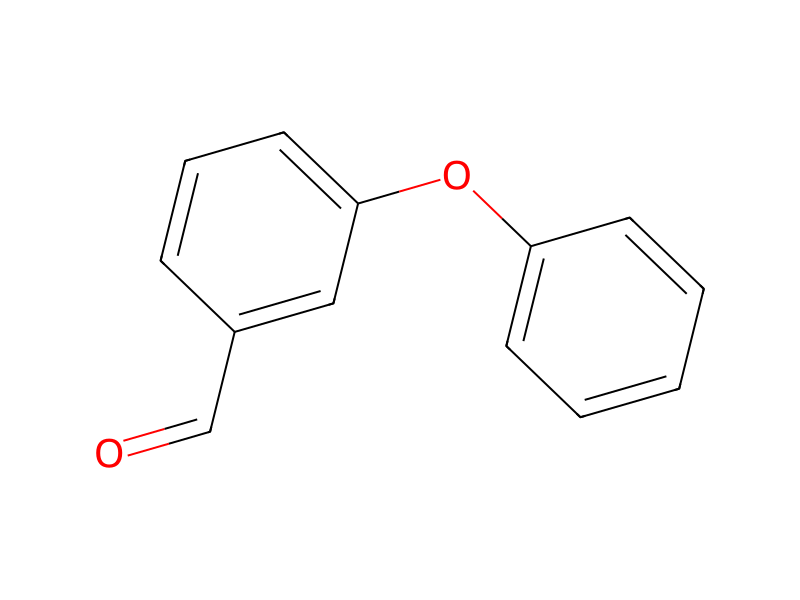
Acetic Acid → 3-Phenoxybenzaldehyde
Reaction equation

[O:1]([C:8]1[CH:9]=[C:10]([CH3:14])[CH:11]=[CH:12][CH:13]=1)[C:2]1[CH:7]=[CH:6][CH:5]=[CH:4][CH:3]=1.[Br-].[Na+].C(O)(=[O:19])C>O.O.O.O.C([O-])(=O)C.[Co+2].C([O-])(=O)C>[O:1]([C:8]1[CH:9]=[C:10]([CH:11]=[CH:12][CH:13]=1)[CH:14]=[O:19])[C:2]1[CH:3]=[CH:4][CH:5]=[CH:6][CH:7]=1Participants
5
Reactant 3



Product 1
Reagents, catalysts & solvents 1

Procedure
Experiments were carried out under such condition that the mixing ratio of m-phenoxytoluene to acetic acid was varied. Using as catalysts 3 mol% of cobalt acetate tetrahydrate and 3 mol% of sodium bromide to m-phenoxytoluene and limiting the total volume of the reaction liquid to 150 ml, the experiments were carried out in the same manner as described in Example 17. The results obtained are shown in Table 21. No substantial intermediate oxidation product was obtained when the amount of acetic acid was zero. When the amount of acetic acid was 0.5 mol per mol of m-phenoxytoluene, m-phenoxybenzaldehyde was obtained at a rate of selection of 20 mol% at a conversion rate of 30%. However, this experiment showed bad reproducibility.
Workup
- customthe total volume of the reaction liquid to 150 ml
- customThe results obtained
Sources & evidence
- ORD record
- ord-b466f9d132904ebe98089c334815bf35
- Source dataset
- uspto-grants-1981_06
- Patent number
- US04272634
Reaction notes
Loading…