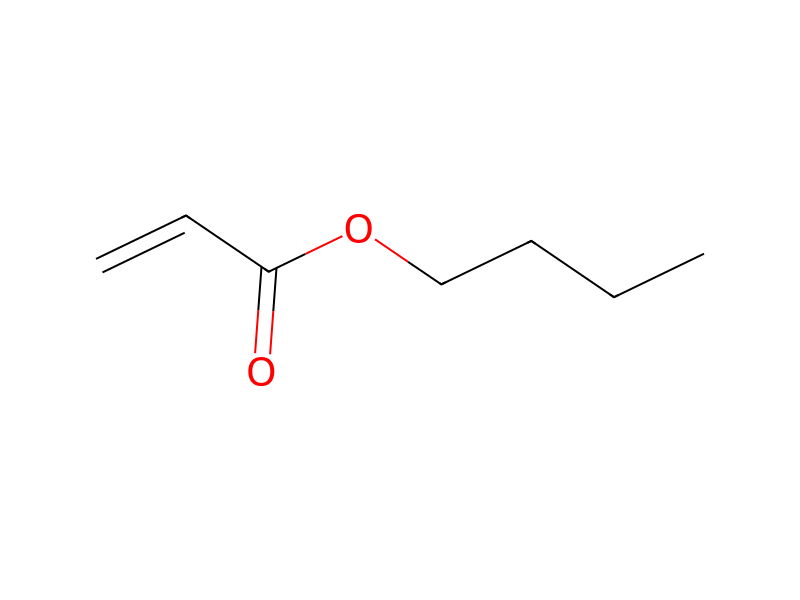
Methyl Methacrylate → Butyl Acrylate
Reaction equation

[C:1]([O:5][CH2:6][CH:7](CC)[CH2:8][CH2:9]CC)(=[O:4])[CH:2]=[CH2:3].C(OCCC(OC(=O)C(C)=C)C)(=O)C(C)=C.C=CC=C.C(OC)(=O)C(C)=C.C(OCCOC(=O)C(C)=C)(=O)C(C)=C>>[C:1]([O:5][CH2:6][CH2:7][CH2:8][CH3:9])(=[O:4])[CH:2]=[CH2:3]Participants


Procedure
Graft-Copolymers A-5, A-6, A-7 and A-8 were prepared by the procedure of Example 18 except that a crosslinked homopolymer of 2-ethylhexyl acrylate obtained through emulsion polymerization using 1% of 1,3-butanediol dimethacrylate as the crosslinking agent, a crosslinked copolymer comprising 55% of 2-ethylhexyl acrylate, 30% of butadiene, and 15% of methyl methacrylate obtained by using 1% of ethyleneglycol dimethacrylate, a crosslinked homopolymer of butyl acrylate obtained by using 1% of 1,3-butanediol dimethacrylate as the crosslinking agent, and a crosslinked homopolymer of butadiene obtained by using 1% of divinylbenzene as the crosslinking agent were respectively used as elastomeric trunk polymers. These graft-copolymers alone are shown in Table 4 as Comparison Examples 10 through 13, all of which exhibited poor powder characteristics.
Workup
- customobtained through emulsion polymerization
- customobtained
Sources & evidence
- ORD record
- ord-c75a633794194befaa67dfe9a8cdb0fd
- Source dataset
- uspto-grants-1981_06
- Patent number
- US04275178
Reaction notes
Loading…