Ethanol → 2-[2-(2-formylphenoxy)ethoxy]benzaldehyde
Reaction equation

[CH:1](=[O:9])[C:2]1[C:3](=[CH:5][CH:6]=[CH:7][CH:8]=1)[OH:4].[OH-:10].[Na+].Br[CH2:13][CH2:14]Br.[CH2:16]([OH:18])[CH3:17]>O>[CH:1]([C:2]1[CH:8]=[CH:7][CH:6]=[CH:5][C:3]=1[O:4][CH2:17][CH2:16][O:18][C:5]1[CH:3]=[CH:2][CH:8]=[CH:7][C:13]=1[CH:14]=[O:10])=[O:9]Participants
Reactant 4

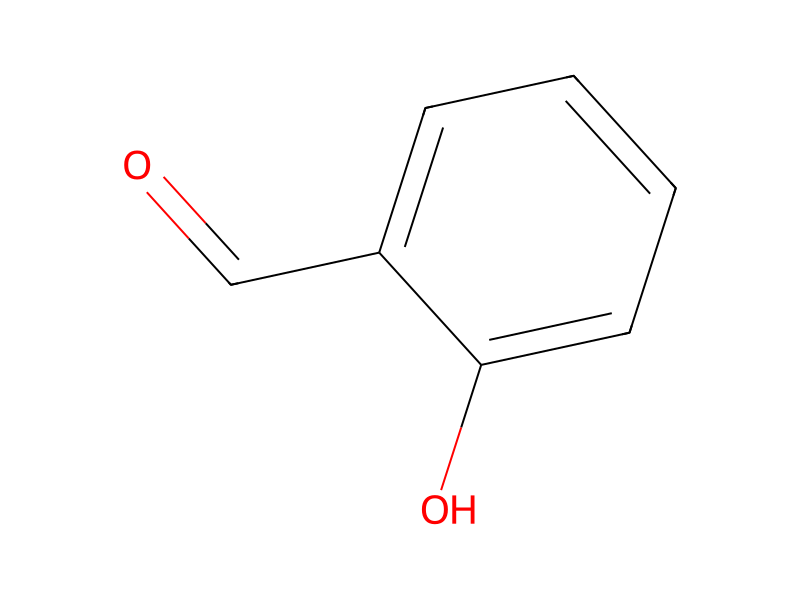


Product 1

Reagents, catalysts & solvents 1

Procedure
Salicylaldehyde (97.6 g) was dissolved in 80 cm3 of ethanol. An aqueous solution of sodium hydroxide (32 g) in 1 dm3 of water was added to give a yellow solution. 1,2-dibromoethane (73.6 g) was then added followed by sufficient ethanol to give an homogeneous solution. The mixture was stirred under nitrogen and heated to reflux temperature and maintained at reflux temperature under nitrogen for 44 hours. The mixture was allowed to cool and a solid precipitated. The solid was filtered off and dried. The solid was mixed with hexane at a temperature of about 65° C., sufficient chloroform was added to dissolve the solid and the mixture was allowed to cool and a solid crystallised. The solid had a melting point of 128°-130° C., corresponding closely to the reported melting point of 129° C. for 1,4-bis(2-formylphenyl)-1,4-dioxabutane.
Workup
- customto give a yellow solution
- customto give an homogeneous solution
- temperatureheated
- temperatureto reflux temperature
- temperaturemaintained
- temperatureat reflux temperature under nitrogen for 44 hours
- temperatureto cool
- customa solid precipitated
- filtrationThe solid was filtered off
- customdried
- additionThe solid was mixed with hexane at a temperature of about 65° C., sufficient chloroform
- additionwas added
- dissolutionto dissolve the solid
- temperatureto cool
- customa solid crystallised
Sources & evidence
- ORD record
- ord-e364b917e03e4fb9b824fbd6ed6a7b11
- Source dataset
- uspto-grants-1992_12
- Patent number
- US05173210
Reaction notes
Loading…