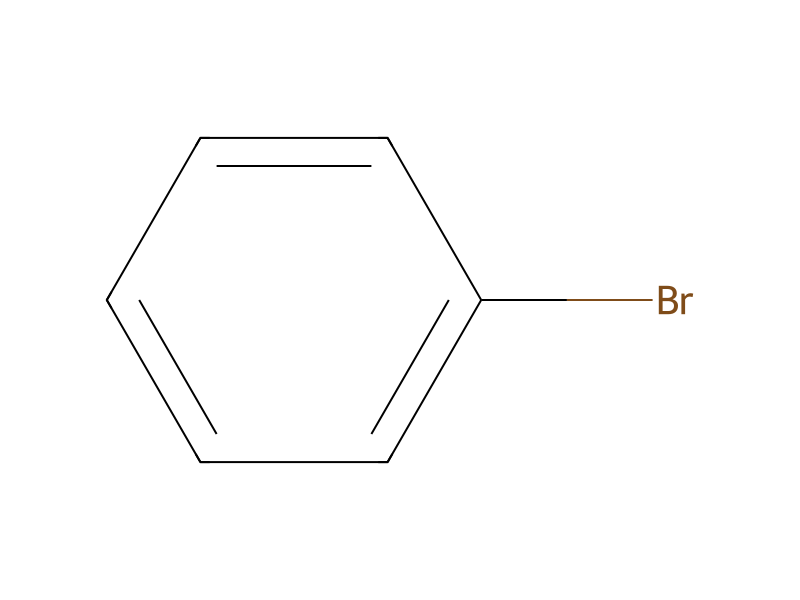
Bromobenzene → 4-(1-Oxo-4-methyl-pentyl) bromobenzene
Reaction equation

CC1C=CC(C2C=CC(C#C)=CC=2)=CC=1.[Br:16][C:17]1[CH:22]=[CH:21][CH:20]=[CH:19][CH:18]=1.[Al+3].[Cl-].[Cl-].[Cl-].[CH3:27][CH:28]([CH3:34])[CH2:29][CH2:30][C:31](O)=[O:32]>>[O:32]=[C:31]([C:20]1[CH:21]=[CH:22][C:17]([Br:16])=[CH:18][CH:19]=1)[CH2:30][CH2:29][CH:28]([CH3:34])[CH3:27]Participants
5




Procedure
Reaction Scheme 5 discloses a specific synthetic route to 4-(4-methylpenyl)-phenylethyne (Compound 26). In accordance with this scheme, bromobenzene (Compound 27) is reacted under Friedel Crafts conditions (AlCl3) with the acid chloride (Compound 28) prepared in situ from 4-methyl valeric acid, to yield 4-(1-oxo-4-methyl-pentyl) bromobenzene (Compuond 29). Compound 29 is reduced under Wolff-Kishner conditions (KOH, NH2NH2) to yield 4-(4-methylpentyl) bromobenzene (Compound 30). The bromobenzene derivative 30 is converted to the ethyne derivative 26 through the intermediate trimethylsilyl ethyne derivative 31 in a manner similar to the conversion described in connection with Reaction Scheme 3. ##STR9##
Workup
- customReaction Scheme 5
Sources & evidence
- ORD record
- ord-ad55c259ad3543b681dffa37ff497d81
- Source dataset
- uspto-grants-1992_12
- Patent number
- US05175185
Reaction notes
Loading…