Methanol → Anthrone
Reaction equation

[CH3:1][OH:2].CCO[CH2:6][CH3:7].O.[CH3:9][CH2:10][CH2:11][CH2:12][CH2:13][CH3:14]>CS(C)=O.N1C=CC=CC=1.C(Cl)(Cl)Cl>[CH:7]1[C:6]2[C:1](=[O:2])[C:13]3[C:14](=[CH:9][CH:10]=[CH:11][CH:12]=3)[CH2:13][C:12]=2[CH:11]=[CH:10][CH:9]=1Participants
Reactant 4




Product 1
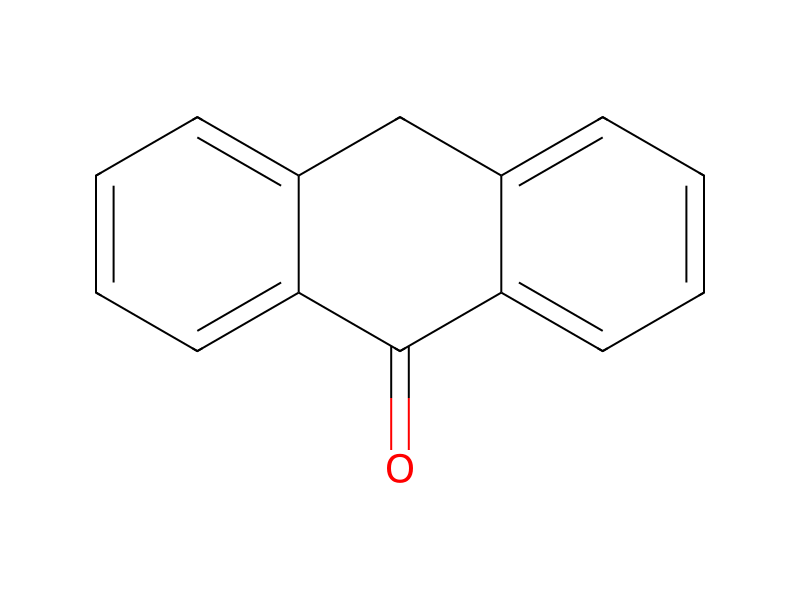
Reagents, catalysts & solvents 3



Procedure
Hayumicins C1, C2 and D were isolated as a purple amorphous powder. The compounds are soluble in dimethylsulfoxide and pyridine, slightly soluble in chloroform and methanol and practically insoluble in n-hexane, ether and water. They give a positive response to anthrone reagent, but are negative to Sakaguchi test. The molecular formulae of Hayumicins C1, C2 and D were determined to be C33H33NO13, C33H33NO13 and C32H31NO13, respectively, based on the high-resolution FAB-MS spectral results. The physico-chemical data of Hayumicin C1 are summarized in Table 6; the physico-chemical data of Hayumicin C2 are summarized in Table 7; and the physico-chemical data of Hayumicin D are summarized in Table 8. The UV and IR spectra of Hayumicins C1, C2 and D are similar to each other. The IR, 1H NMR and 13C NMR spectra of Hayumicin C1 are shown in FIGS. 7, 8 and 9, respectively. The IR spectra of Hayumicins C2 and D are shown in FIGS. 10 and 11, respectively. The 1H NMR spectra of Hayumicins C2 and D are shown in FIGS. 12 and 13, respectively. The structures of Hayumicins C1, C2 and D were elucidated on the basis of comparison studies of their 1H and 13C NMR spectra with those of Hayumicin B. They were found to be des-methyl congeners of Hayumicin B with one methyl missing in Hayumicins C1 and C2 and two methyls missing in Hayumicin D on their sugar moieties.
Sources & evidence
- ORD record
- ord-986dfc07e412451e8fb47271d7b26e03
- Source dataset
- uspto-grants-1997_06
- Patent number
- US05639735
Reaction notes
Loading…