m-Chloroperbenzoic acid → 3-(Benzyloxy)-4-methoxyphenol
Reaction equation

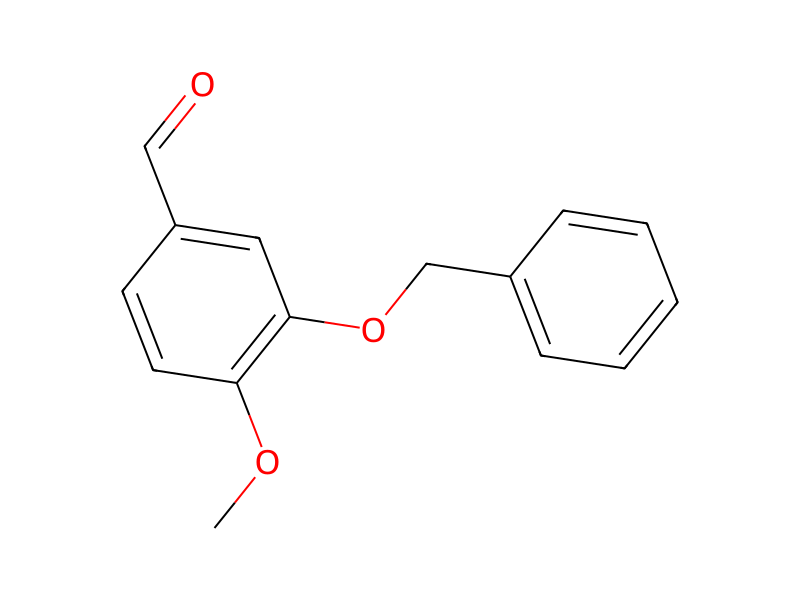
[CH2:1]([O:8][C:9]1[CH:10]=[C:11]([CH:14]=[CH:15][C:16]=1[O:17][CH3:18])C=O)[C:2]1[CH:7]=[CH:6][CH:5]=[CH:4][CH:3]=1.ClC1C=CC=C(C(OO)=[O:27])C=1>CO>[CH2:1]([O:8][C:9]1[CH:10]=[C:11]([OH:27])[CH:14]=[CH:15][C:16]=1[O:17][CH3:18])[C:2]1[CH:7]=[CH:6][CH:5]=[CH:4][CH:3]=1Participants
Reactant 2

Product 1

Reagents, catalysts & solvents 1

Procedure
FIGS. 17 and 18 disclose a procedure for synthesizing futoenone and futoenone derivative compounds. Benzyl bromide (BnBr) is used to protect isovanillin (201) by reaction using phase transfer conditions to yield 3-benzyloxy-4-methoxybenzaldehyde (202). Oxidation of 3-benzyloxy-4-methoxybenzaldehyde (202) with m-chloroperbenzoic acid followed by hydrolysis in refluxing methanol yields 3-benzyloxy-4-methoxyphenol (203). The phenol is placed in toluene and the suspension is treated with n-butyl-lithium to form a precipitate. 1,4-dibromobutene is then added to the reaction and the contents are heated to reflux overnight to form vinylbenzofuran (206). An ester (207) is formed using a Horner-Emmons modified Wittig reaction and is subsequently reduced to the allylic alcohol (208) using diisobutylaluminum hydride. The allylic alcohol can then be epoxidized in a Sharpless epoxidation to form 2-(2,3'-epoxybutanol)-7-benzyloxy-6-methoxydihydrobenzofuran (209).
Sources & evidence
- ORD record
- ord-64181885f2de4db2943535c043c59d48
- Source dataset
- uspto-grants-1997_06
- Patent number
- US05639782
Reaction notes
Loading…