Methanol → (1-Trityl-1H-imidazol-4-yl)acetic acid
Reaction equation

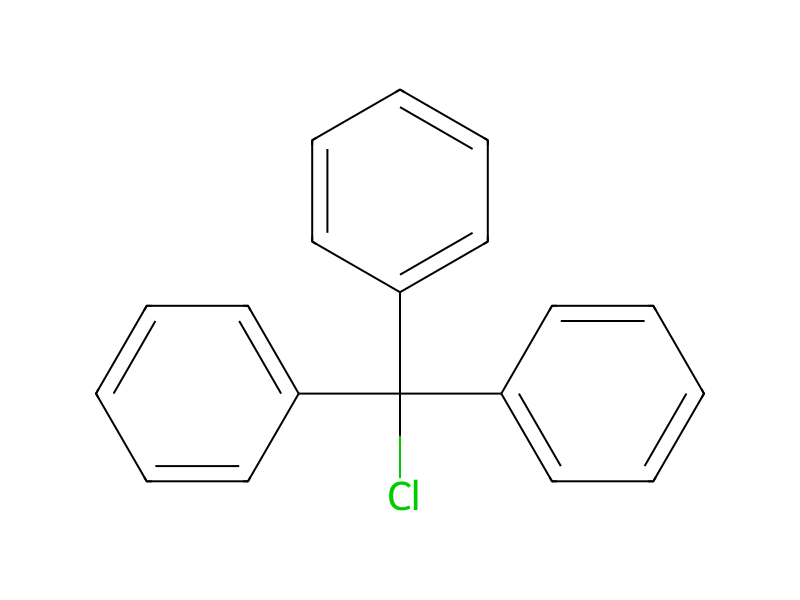
[C:1](Cl)([C:14]1[CH:19]=[CH:18][CH:17]=[CH:16][CH:15]=1)([C:8]1[CH:13]=[CH:12][CH:11]=[CH:10][CH:9]=1)[C:2]1[CH:7]=[CH:6][CH:5]=[CH:4][CH:3]=1.Cl.[NH:22]1[CH:26]=[C:25]([CH2:27][C:28]([OH:30])=[O:29])[N:24]=[CH:23]1.CO>N1C=CC=CC=1.C(OCC)C>[C:1]([N:22]1[CH:26]=[C:25]([CH2:27][C:28]([OH:30])=[O:29])[N:24]=[CH:23]1)([C:14]1[CH:19]=[CH:18][CH:17]=[CH:16][CH:15]=1)([C:8]1[CH:13]=[CH:12][CH:11]=[CH:10][CH:9]=1)[C:2]1[CH:7]=[CH:6][CH:5]=[CH:4][CH:3]=1Participants
Reactant 3


Product 1

Reagents, catalysts & solvents 2


Procedure
Trityl chloride (51 g, 0.18 mol) is added to a suspension of (1H-imidazol-4-yl)acetic acid hydrochloride (25 g, 0.15 mol) in pyridine (500 mL, 0.3 M). This is stirred at room temperature for 16 h, at the end of which MeOH (150 mL) is added. This solution is stirred at room temperature for 1 h. Solvents are evaporated and the residue is taken up in CH2Cl2 and washed twice with 1 M aqueous citric acid solution and brine. The organic phase is dried over anhydrous Na2SO4 and evaporated to give a sticky residue which when taken up in diethyl ether and evaporated gives the product as a white solid that is used without further purification; MS (ESI) m/z 368.9 (M+H) (Procedure adapted from J. Org. Chem. 1993, 58, 4606, also prepared in WO2003013526).
Workup
- additionis added
- customSolvents are evaporated
- washwashed twice with 1 M aqueous citric acid solution and brine
- dry with materialThe organic phase is dried over anhydrous Na2SO4
- customevaporated
- customto give a sticky residue which when
- customevaporated
Sources & evidence
- ORD record
- ord-f0a47af231aa47d08079db8d1e18ffe6
- Source dataset
- uspto-grants-2012_04
- Patent number
- US08153674B2
Reaction notes
Loading…