Dichloroacetyl chloride → 1,1-Dichloro-4-ethoxy-3-buten-2-one
Reaction equation

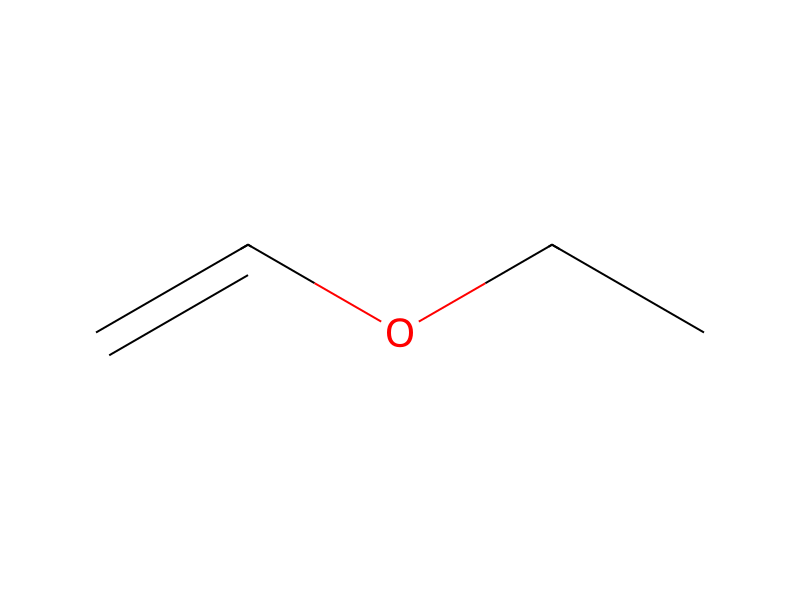
[Cl:1][CH:2]([Cl:6])[C:3](Cl)=[O:4].[CH:7]([O:9][CH2:10][CH3:11])=[CH2:8]>>[Cl:1][CH:2]([Cl:6])[C:3](=[O:4])[CH:8]=[CH:7][O:9][CH2:10][CH3:11]Participants
3


Procedure
At about 0° C., dichloroacetyl chloride (95% pure, 16.5 g, 0.11 mol) and ethyl vinyl ether (99% pure, 48.7 g, 0.67 mol) were added and stirred for 5 h. The mixture was then stirred at 22° C. for about 11 h. Most of the excess ethyl vinyl ether was then removed by distillation under reduced pressure (40° C./300-400 mbar). The product was separated off from the residue (18.7 g) by flash distillation (oil bath 100° C./0.7 mbar; transition 72° C.). The distillate obtained was a product mixture (15.6 g). This consisted to 80% (GC area %) of the desired product. Furthermore, the product mixture consisted to about 5% (GC area %) of 1,1-dichloro-4,4-diethoxy-2-butanone. Including the corresponding diethyl acetal, the yield was about 68%.
Workup
- stirringThe mixture was then stirred at 22° C. for about 11 h
- customMost of the excess ethyl vinyl ether was then removed by distillation under reduced pressure (40° C./300-400 mbar)
- customThe product was separated off from the residue (18.7 g) by flash distillation (oil bath 100° C./0.7 mbar; transition 72° C.)
- customThe distillate obtained
Sources & evidence
- ORD record
- ord-5b8c527c573d41a4b7705e96c5dc5598
- Source dataset
- uspto-grants-2012_04
- Patent number
- US08153820B2
Reaction notes
Loading…