Benzyl Alcohol → HCID 67278511, compound
Reaction equation

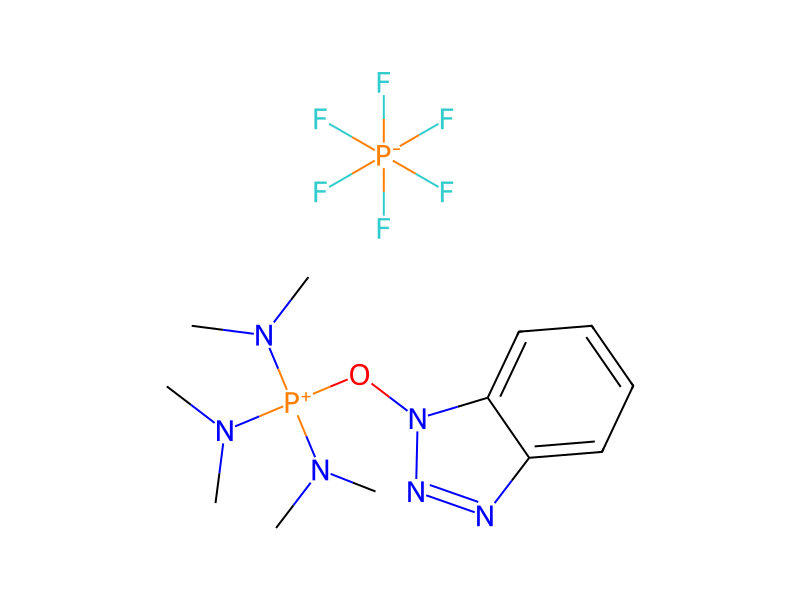
[Li][CH2:2][CH2:3][CH2:4][CH3:5].CCCCC[CH2:11][CH3:12].C(O)C1C=CC=CC=1.BrC1C=CC([CH2:26][N:27]2[CH2:31][CH2:30][CH2:29][C@H:28]2[CH3:32])=C(Cl)C=1.[O:36]=[C:37]1[CH2:40][CH:39]([C:41]([OH:43])=O)[CH2:38]1.[ClH:44].[NH:45]1[CH2:49][CH2:48][CH2:47][CH2:46]1.F[P-](F)(F)(F)(F)F.N1(O[P+](N(C)C)(N(C)C)N(C)C)C2C=CC=CC=2N=N1>C1COCC1>[Cl:44][C:3]1[CH:4]=[C:5]([C:37]2([OH:36])[CH2:38][CH:39]([C:41]([N:45]3[CH2:49][CH2:48][CH2:47][CH2:46]3)=[O:43])[CH2:40]2)[CH:11]=[CH:12][C:2]=1[CH2:26][N:27]1[CH2:31][CH2:30][CH2:29][C@H:28]1[CH3:32]Participants
Reactant 7





Product 1

Reagents, catalysts & solvents 1

Conditions
- Temperature
- -79 °C
Procedure
A 2.7 M solution of n-BuLi in heptane (3.6 mL, 9.6 mmol) was added for 5 min to a solution of intermediate 4, (2R)-1-(4-bromo-2-chlorobenzyl)-2-methylpyrrolidine. (2.52 g, 8.8 mmol) in absolute THF (20 ml) in a flow of argon at −78 to −80° C. The reaction mixture was stirred at −78 to −80° C. for 15 min. Then a solution of 3-oxocyclobutanecarboxylic acid (500 mg, 4.4 mmol) in absolute THF (4 mL) was added drop wise over 5 min at −80° C. The mixture was warmed to 0° C. for 1 h and evaporated to dryness. The residue was dissolved in DMF (10 mL), Intermediate 5, pyrrolidine HCl (520 mg, 4.8 mmol) was added. Then BOP (2.2 g, 4.8 mmol) was added in portions under cooling in an ice bath for 16 h at room temperature. The disappearance of the starting hydroxy acid was monitored by LC/MS. The reaction mass was evaporated to dryness under 1 mmHg. Water (100 mL), EtOAc (50 mL), and a saturated solution of K2CO3 (to pH 10) were added. The layers were separated, and the aqueous one was subjected to extraction with EtOAc (2×50 mL). The combined organic layer was washed with water (50 mL), brine, dried with Na2SO4, and evaporated. The residue was purified by chromatography (60 mL of silica gel 63/100 μm, hexane/CHCl3 20:80→0:100, then CHCl3/MeOH 100:0→90:10). The product-containing fraction were collected and concentrated to give the title compound (1.03 g, 63%). LC/MS data: 377.2 and 379.2 (M)+ (calculated for C21H29ClN2O2 376.93). 1H NMR data (DMSO-d6), δ 7.51 (s, 1H, Ar—H); 7.42-7.49 (m, 2H, Ar—H), 5.75 (s, 1H, OH); 3.96 (d, 1H, J=13.7 Hz), 3.25-3.35 (m, ?H+H2O); 2.78-2.90 (m, 2H); 2.53-2.60 (m, 2H); 2.43-2.52 (m, ?H+DMSO); 2.06-2.16 (m, 1H); 1.88-1.97 (m, 1H); 1.80-1.87 (m, 2H); 1.72-1.79 (m, 2H); 1.57-1.67 (m, 2H); 1.29-1.40 (m, 1H); 1.11 (d, 3H, J=5.8 Hz, CH3).
Workup
- customat −78 to −80° C
- temperatureThe mixture was warmed to 0° C. for 1 h
- customevaporated to dryness
- dissolutionThe residue was dissolved in DMF (10 mL)
- temperatureunder cooling in an ice bath for 16 h at room temperature
- customThe reaction mass was evaporated to dryness under 1 mmHg
- additionWater (100 mL), EtOAc (50 mL), and a saturated solution of K2CO3 (to pH 10) were added
- customThe layers were separated
- extractionthe aqueous one was subjected to extraction with EtOAc (2×50 mL)
- washThe combined organic layer was washed with water (50 mL), brine
- dry with materialdried with Na2SO4
- customevaporated
- customThe residue was purified by chromatography (60 mL of silica gel 63/100 μm, hexane/CHCl3 20:80→0:100
- customThe product-containing fraction were collected
- concentrationconcentrated
Sources & evidence
- ORD record
- ord-626315b48ca14989b7039d5b245616ef
- Source dataset
- uspto-grants-2012_04
- Patent number
- US08158673B2
Reaction notes
Loading…