Hydrochloric Acid → HCID 178505918, compound
Reaction equation
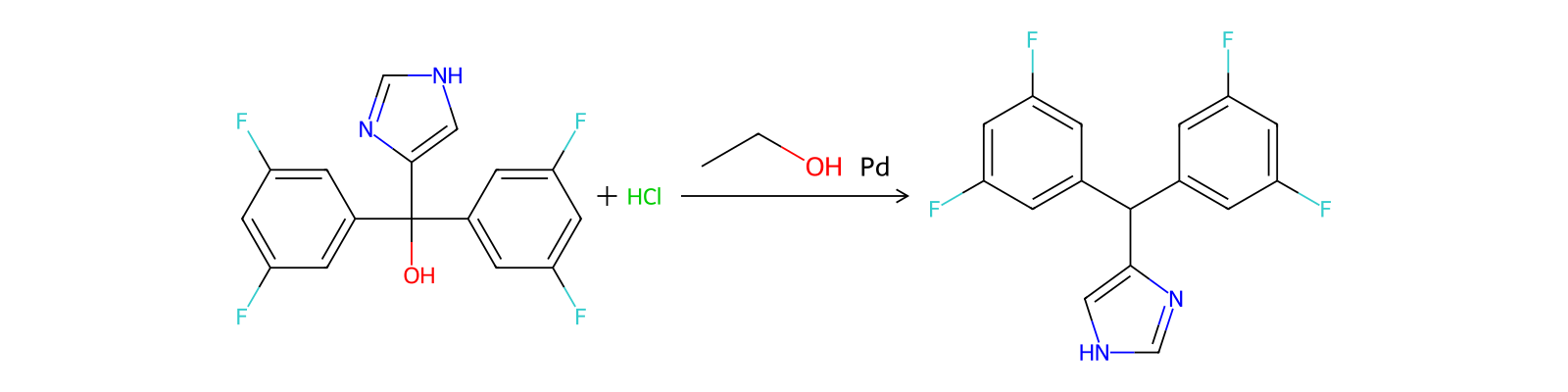
[F:1][C:2]1[CH:3]=[C:4]([C:9]([C:16]2[CH:21]=[C:20]([F:22])[CH:19]=[C:18]([F:23])[CH:17]=2)([C:11]2[N:12]=[CH:13][NH:14][CH:15]=2)O)[CH:5]=[C:6]([F:8])[CH:7]=1.Cl>C(O)C.[Pd]>[F:1][C:2]1[CH:3]=[C:4]([CH:9]([C:16]2[CH:21]=[C:20]([F:22])[CH:19]=[C:18]([F:23])[CH:17]=2)[C:11]2[N:12]=[CH:13][NH:14][CH:15]=2)[CH:5]=[C:6]([F:8])[CH:7]=1Participants
5
Reactant 2


Product 1

Reagents, catalysts & solvents 2


Procedure
Bis-(3,5-difluoro-phenyl)-(1H-imidazol-4-yl)-methanol (0.5 g, 1.55 mmol) was dissolved in 10 ml ethanol and 0.66 ml of 12M hydrochloric acid was added. The mixture was hydrogenated (5% Pd/C, 0.07 g; 100 bar H2, 100° C.) for 20 h. Then the mixture was filtered through Celite®, and the solvent was evaporated. The residue was partitioned between an aqueous solution of potassium carbonate and ethyl acetate. The organic layer was dried over magnesium sulfate and evaporated. The residue was purified by flash chromatography (silica gel, ethyl acetate) to yield 0.2 g (42%) of 4-[bis-(3,5-difluoro-phenyl)-methyl]-1H-imidazole as a white solid; MS (ISP): 307.1 ((M+H)+.).
Workup
- customfor 20 h
- filtrationThen the mixture was filtered through Celite®
- customthe solvent was evaporated
- customThe residue was partitioned between an aqueous solution of potassium carbonate and ethyl acetate
- dry with materialThe organic layer was dried over magnesium sulfate
- customevaporated
- customThe residue was purified by flash chromatography (silica gel, ethyl acetate)
Sources & evidence
- ORD record
- ord-13f91a7c36be4d26b28da40589c882b1
- Source dataset
- uspto-grants-2012_04
- Patent number
- US08158668B2
Reaction notes
Loading…