Pyridine → 2-(4-Chlorophenoxy)isoindoline-1,3-dione
Reaction equation

N1C=CC=CC=1.[OH:7][N:8]1[C:12](=[O:13])[C:11]2=[CH:14][CH:15]=[CH:16][CH:17]=[C:10]2[C:9]1=[O:18].[Cl:19][C:20]1[CH:25]=[CH:24][C:23](B(O)O)=[CH:22][CH:21]=1>C(Cl)Cl>[Cl:19][C:20]1[CH:25]=[CH:24][C:23]([O:7][N:8]2[C:9](=[O:18])[C:10]3=[CH:17][CH:16]=[CH:15][CH:14]=[C:11]3[C:12]2=[O:13])=[CH:22][CH:21]=1Participants
5
Reactant 3

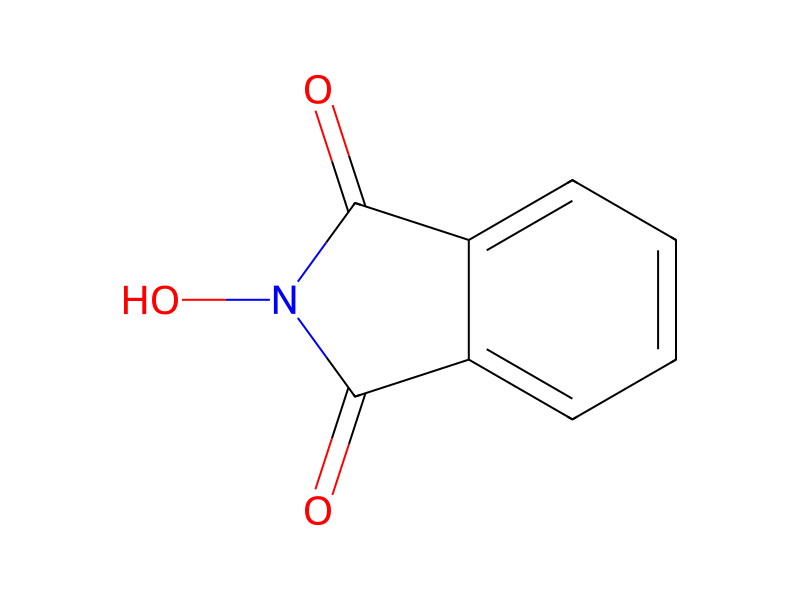

Product 1

Reagents, catalysts & solvents 1

Procedure
Pyridine (0.37 mL, 4.6 mmol) was added to a suspension of N-hydroxyphthalimide (664 mg, 4.1 mmol), 4-chlorophenylboronic acid (635 mg, 4.1 mmol), and powdered 4 Å molecular sieves (1.02 g) in CH2Cl2 (20 mL). Cupric acetate monohydrate (812 mg, 4.1 mmol) was added, and the mixture was stirred open to the atmosphere at room temperature for 18 hours. Silica gel (10 g) was added, and the slurry was concentrated to dryness under vacuum. The residue was applied to the top of a flash chromatography column, and eluted with hexanes:ethyl acetate (80:20) to provide the title compound. 1H NMR (300 MHz, CDCl3) δ 7.11-7.17 (m, 2 H), 7.27-7.34 (m, 2 H), 7.79-7.87 (m, 2 H), 7.88-7.95 ppm (m, 2 H).
Workup
- additionSilica gel (10 g) was added
- concentrationthe slurry was concentrated to dryness under vacuum
- washeluted with hexanes:ethyl acetate (80:20)
Sources & evidence
- ORD record
- ord-346669d5ca524b45a366a311e2e03b44
- Source dataset
- uspto-grants-2012_04
- Patent number
- US08163915B2
Reaction notes
Loading…