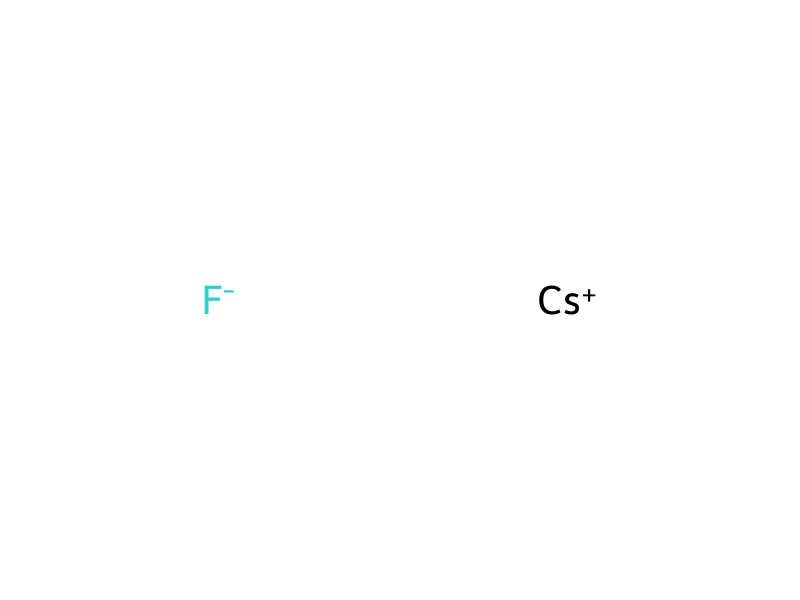
Cesium fluoride → HCID 18319180, compound
Reaction equation

Br[C:2]1[CH:7]=[CH:6][C:5]([N+:8]([O-:10])=[O:9])=[CH:4][C:3]=1[CH3:11].[C:12]([C:14]1[CH:19]=[CH:18][C:17](B(O)O)=[CH:16][CH:15]=1)#[N:13].[F-].[Cs+]>COCCOC.CC1C=CC=CC=1P(C1C=CC=CC=1C)C1C=CC=CC=1C>[C:12]([C:14]1[CH:19]=[CH:18][C:17]([C:2]2[CH:7]=[CH:6][C:5]([N+:8]([O-:10])=[O:9])=[CH:4][C:3]=2[CH3:11])=[CH:16][CH:15]=1)#[N:13]Participants




Procedure
A mixture of 2-bromo-5-nitrotoluene (7.05 gm, 32.67 mmol), 4-cyanophenylboronic acid (Tet. Lett., 1993, 34, 8237)(6.0 gm, 40.83 mmol), caesium fluoride (11.02 gm, 72.53 mmol) and tri-(2-methylphenyl)phosphine (1.0 gm, 3.27 mmol) in 1,2-dimethoxyethane (240 mL) were stirred under an atmosphere of nitrogen at room temperature for 40 mins. Tris(dibenzylideneacetone)dipalladiumn (1.50 gm, 1.63 mmol) was added and stirred for 10 mins at room temperature, then heated at 80° C. for 4 h. After being cooled, the mixture was partitioned between ethyl acetate and saturated aqueous sodium bicarbonate. The organic phase was separated, washed with water, then dried (Na2SO4) and concentrated under reduced pressure to give crude 1-(4-cyanophenyl)-2-methyl-4-nitrobenzene (9.78 gm) which was used without further purification.
Workup
- stirringstirred for 10 mins at room temperature
- temperatureheated at 80° C. for 4 h
- temperatureAfter being cooled
- customthe mixture was partitioned between ethyl acetate and saturated aqueous sodium bicarbonate
- customThe organic phase was separated
- washwashed with water
- dry with materialdried (Na2SO4)
- concentrationconcentrated under reduced pressure
Sources & evidence
- ORD record
- ord-626f2f455ac4431f81fc64664c6fd7bd
- Source dataset
- uspto-grants-2002_02
- Patent number
- US06350907B1
Reaction notes
Loading…