Carbon Dioxide → 2-Biphenylylsulfonylisocyanate
Reaction equation

[C:1](=[O:3])=O.[C:4]1([C:14]2[CH:19]=[CH:18][CH:17]=[CH:16][CH:15]=2)[C:5]([S:10]([NH2:13])(=[O:12])=[O:11])=[CH:6][CH:7]=[CH:8][CH:9]=1.C(N=C=O)CCC.C(Cl)(Cl)=O.S(N=C=O)(N=C=O)(=O)=O>C1(C)C(C)=CC=CC=1>[C:4]1([C:14]2[CH:15]=[CH:16][CH:17]=[CH:18][CH:19]=2)[C:5]([S:10]([N:13]=[C:1]=[O:3])(=[O:12])=[O:11])=[CH:6][CH:7]=[CH:8][CH:9]=1Participants





Procedure
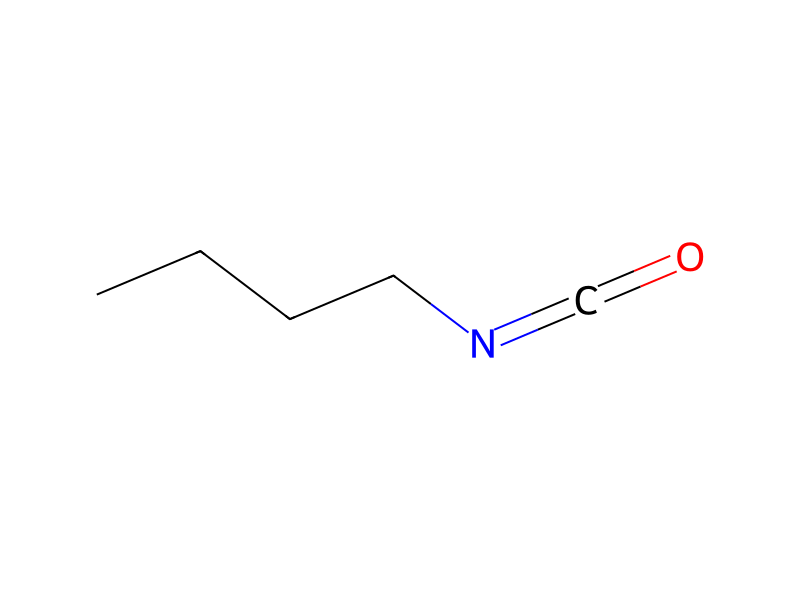
Into a dry, 500 ml, 3 neck round bottom flask, equipped with a dry-ice-cooled reflux condenser, stirrer, gas inlet tube and thermometer was charged 12 g of 1,1'-biphenyl-2-sulfonamide, 100 ml of xylene, 0.2 g of 1,4-diaza[2.2.2]bicyclooctane (DABCO) and 5 g of n-butyl isocyanate. The mixture was heated to 135° and then phosgene was passed into the system until the temperature dropped to 125°. Heating was continued to bring the mixture up to 135° and additional phosgene was added to lower the temperature to 120°. This cycling was repeated until the temperature of the refluxing mixture remained at 120° without further addition of phosgene. The mixture was then allowed to cool to room temperature, filtered and concentrated in vacuo. Any contact with moisture was scrupulously avoided due to the extreme reactivity of the sulfonyl isocyanate. The product thus obtained (yield 10.4 g) showed an absorption peak in the infrared spectrum at 2200 cm-1, consistent with a sulfonyl isocyanate.
Workup
- temperaturecooled
- temperaturereflux condenser, stirrer, gas inlet tube
- temperatureThe mixture was heated to 135°
- additiondropped to 125°
- temperatureHeating
- additionwas added
- customto 120°
- filtrationfiltered
- concentrationconcentrated in vacuo
- customThe product thus obtained (yield 10.4 g)
Sources & evidence
- ORD record
- ord-03fc921da2c44e558885bd04a47225f0
- Source dataset
- uspto-grants-1983_04
- Patent number
- US04378991
Reaction notes
Loading…