Calcium Hydroxide → Sorbitol
Reaction equation

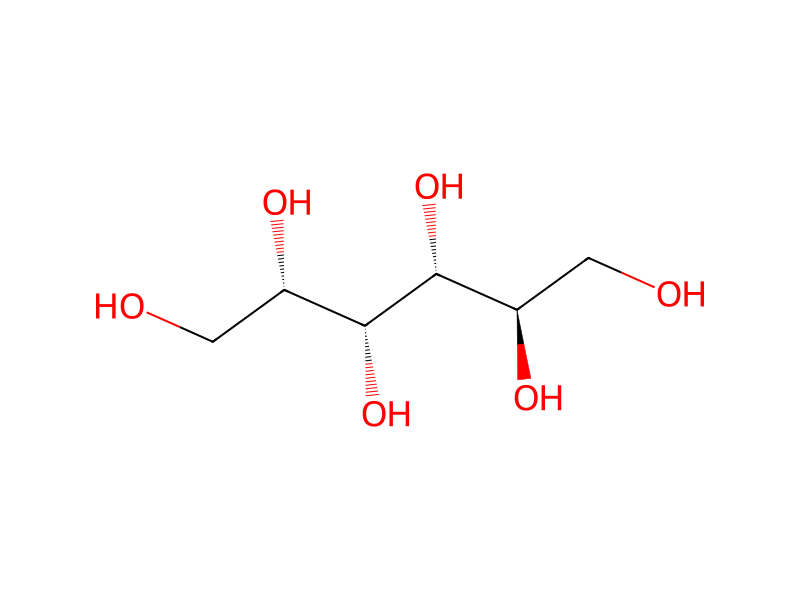
[O:1]=[CH:2][C@@H:3]([C@H:5]([C@@H:7]([C@@H:9]([CH2:11][OH:12])[OH:10])[OH:8])[OH:6])[OH:4].O.[OH-].[Ca+2].[OH-].[H][H]>>[OH:12][CH2:11][C@@H:9]([C@H:7]([C@@H:5]([C@@H:3]([CH2:2][OH:1])[OH:4])[OH:6])[OH:8])[OH:10]Participants



Procedure
As shown in the drawing, a glucose-water feed solution at 10 is mixed with an alkaline promotor material at 11 such as calcium hydroxide. The resulting mixture is pressurized and passed with hydrogen from 12 through preheater 14 to fixed-bed catalytic reactor 16 for hydrogenation reaction to produce mainly sorbitol. The promotor material added at 11 should be sufficient to control pH of feedstream to range of 7-14 to prevent leaching damage to the catalyst in reactor 16. The catalyst is preferably a reduced and stabilized nickel on silica-alumina support, and usually contains 50-66 W % nickel. Catalyst particle size of 0.060 to 0.250 inch can be used. The reaction conditions which can be used in reactor 16 are 130°-180° C. temperature, 500-2000 psig hydrogen partial pressure, and 0.5-3.5 Vf/hr/Vc space velocity to achieve at least about 90 W % conversion of the glucose feed to sorbitol solution.
Workup
- custom16 for hydrogenation reaction
Sources & evidence
- ORD record
- ord-75d85a6dd2d842b791efd81ec5cf8b66
- Source dataset
- uspto-grants-1983_04
- Patent number
- US04380678
Reaction notes
Loading…