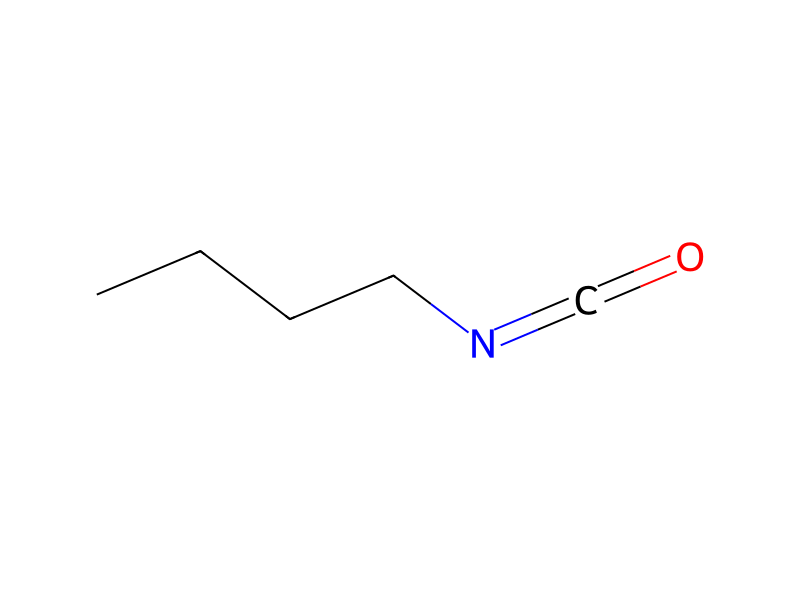
Butyl isocyanate → 5-(n-Butylcarbamoyloxy)-1,3-benzoxathiol-2-one
Reaction equation

[OH:1][C:2]1[CH:3]=[CH:4][C:5]2[O:9][C:8](=[O:10])[S:7][C:6]=2[CH:11]=1.[CH2:12]([N:16]=[C:17]=[O:18])[CH2:13][CH2:14][CH3:15].C(N(CC)CC)C>C(C(C)=O)C>[CH2:12]([NH:16][C:17]([O:1][C:2]1[CH:3]=[CH:4][C:5]2[O:9][C:8](=[O:10])[S:7][C:6]=2[CH:11]=1)=[O:18])[CH2:13][CH2:14][CH3:15]Participants
5
Reactant 3


Product 1

Reagents, catalysts & solvents 1

Procedure
5-hydroxy-1,3-benzoxathiol-2-one (14.3 grams) was mixed with n-butyl isocyanate (8.85 grams) in 175 milliliters of methyl ethyl ketone in the presence of 1.3 milliliters of triethylamine. The reaction mixture was then heated at reflux temperature for 2.5 hours. The solvent was then removed from the reaction mixture by evaporation in vacuo. The off-white solid residue was recrystallized from toluene and the purified product, 5-(n-butylcarbamoyloxy)-1,3-benzoxathiol-2-one was obtained, as a white, fluffy, crystalline solid with a melting point of 99°-100° C. Elemental analysis calculated for C12H13NO4S (percent): carbon--53.92; hydrogen--4.90; nitrogen--5.24. Found: carbon--54.1; hydrogen--4.89; nitrogen--5.27.
Workup
- temperatureThe reaction mixture was then heated
- temperatureat reflux temperature for 2.5 hours
- customThe solvent was then removed from the reaction mixture by evaporation in vacuo
- customThe off-white solid residue was recrystallized from toluene
Sources & evidence
- ORD record
- ord-e052c282bc43495fbd8e68718914f49e
- Source dataset
- uspto-grants-1982_09
- Patent number
- US04349685
Reaction notes
Loading…