Acrylonitrile → 2,3-Dichloropropiononitrile
Reaction equation

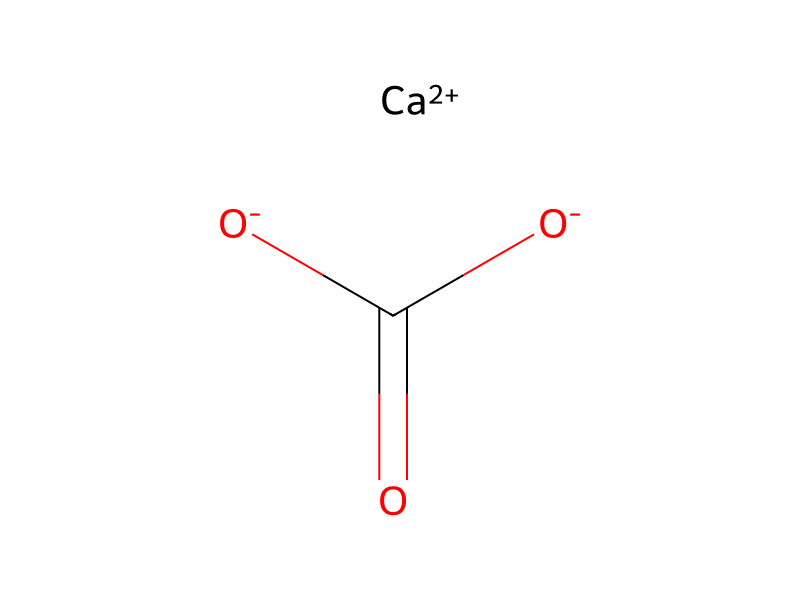
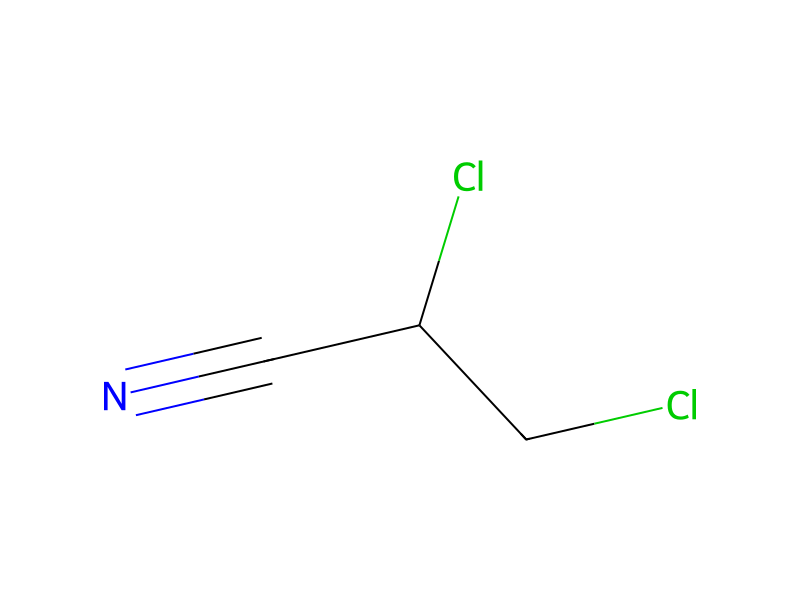
[C:1](#[N:4])[CH:2]=[CH2:3].C(=O)([O-])[O-].[Ca+2].[Cl:10][CH:11]([CH2:14][Cl:15])[C:12]#[N:13].ClCl>>[C:1](#[N:4])[CH:2]=[CH2:3].[Cl:10][C:11](=[CH2:14])[C:12]#[N:13].[Cl:10][CH:11]([CH2:14][Cl:15])[C:12]#[N:13]Participants



Procedure
In the same way as in Example 1, 53.1 g of acrylonitrile was chlorinated at 20° to 25° C. in the presence of 20.0 g (0.2 mole) of anhydrous calcium carbonate. When the weight of the reaction solution reached 124 g which was the weight showing that 2,3-dichloropropionitrile was formed in a calculated amount, the reaction was stopped. Chlorine dissolved in the reaction solution was removed with nitrogen. The weight of the reaction product at this time was 116.6 g. The catalyst was separated by filtration, and the reaction solution was distilled under reduced pressure to afford 0.7 g of acrylonitrile as a first fraction boiling at 23° C. (100 mmHg), 3.1 g (yield of 4.2% based on acrylonitrile) of 2-chloroacrylonitrile as a second fraction boiling at 43°-44° C. (150 mmHg), and 112.3 g (yield of 90.5% based on acrylonitrile) of 2,3-dichloropropionitrile as a third fraction boiling at 62°-63° C. (13 mmHg).
Workup
- customwas formed in a calculated amount
- customwas removed with nitrogen
- customThe catalyst was separated by filtration
- distillationthe reaction solution was distilled under reduced pressure
Sources & evidence
- ORD record
- ord-b3c0f83f714743168460633381c9e9fc
- Source dataset
- uspto-grants-1982_09
- Patent number
- US04350643
Reaction notes
Loading…