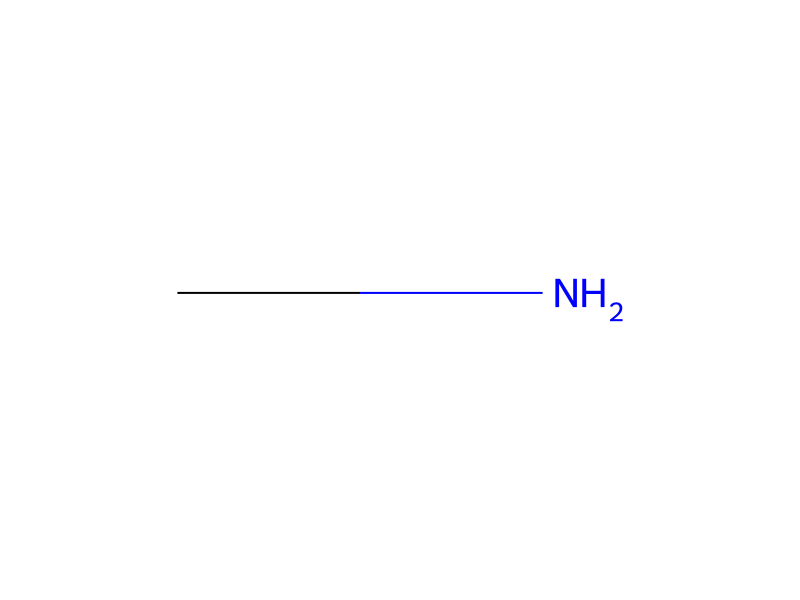
1,1-Bis(methylthio)-2-nitroethylene → Methylamine
Reaction equation

BrCCCC1C=CC=[C:7]2[C:8]([NH:10][C:11](=O)C=12)=O.[CH3:16][C:17]1[N:18]=[CH:19][O:20][C:21]=1[CH2:22][S:23][CH2:24][CH2:25][NH2:26].[N+:27](C=C(SC)SC)([O-:29])=[O:28]>>[CH3:8][NH2:10].[N+:27]([CH:7]=[C:8]([NH:10][CH3:11])[NH:26][CH2:25][CH2:24][S:23][CH2:22][C:21]1[O:20][CH:19]=[N:18][C:17]=1[CH3:16])([O-:29])=[O:28]Participants



Procedure
Phthalimidoethanethiol (2 g) was added portionwise with stirring to a solution of sodium ethoxide (prepared from 0.23 g of sodium) in ethanol (20 ml) at 0° under a nitrogen atmosphere. After stirring at 0° for a further 21/2 hours, the resulting yellow solution was cooled with an ice-salt bath and a solution of 4-methyl-5-chloromethyloxazole (0.86 g) in ethanol (5 ml) was added dropwise over 10 minutes. After addition the mixture was stirred at room temperature overnight, then acidified with ethanolic hydrogen chloride and evaporated to dryness. Addition of water precipitated unreacted phthalimidoethanethiol (0.6 g) which was removed by filtration. The filtrate was concentrated and basified with aqueous sodium bicarbonate solution to furnish a white precipitate which, on recrystallisation from aqueous ethanol, gave 4-methyl-5-[(2-phthalimidoethyl)thiomethyl]oxazole (0.75 g). A stirred mixture of this phthalimido derivative (0.62 g) in aqueous hydrobromic acid (40 ml. 18%) was heated under reflux overnight. After cooling to 0°, the resulting clear solution was filtered and the filtrate evaporated to dryness. Recrystallisation of the residue from ethanol gave 4-methyl-5-[(2-aminoethyl)thiomethyl]oxazole dihydrobromide (0.52 g). (ii) Reacting 4-methyl-5-[(2-aminoethyl)thiomethyl]oxazole with 1-nitro-2,2-bis-methylthioethylene and then with methylamine by the procedure of Example 8 gives the title product.
Sources & evidence
- ORD record
- ord-d493ca28631e4dd38628169ca416eed5
- Source dataset
- uspto-grants-1978_11
- Patent number
- US04124717
Reaction notes
Loading…