Sodium Hydroxide → Pyridine, 2,3,5-trichloro-
Reaction equation

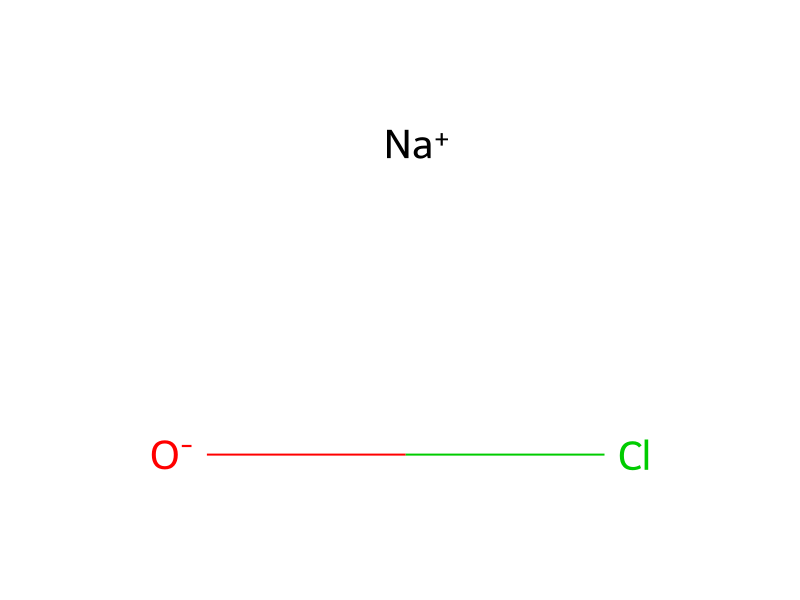
[Cl:1][C:2]1[C:7]([Cl:8])=[CH:6][C:5]([Cl:9])=[C:4](NN)[N:3]=1.[OH-].[Na+].Cl[O-].[Na+]>C1(C)C=CC=CC=1>[Cl:1][C:2]1[C:7]([Cl:8])=[CH:6][C:5]([Cl:9])=[CH:4][N:3]=1Participants
Reactant 3


Product 1

Reagents, catalysts & solvents 1

Conditions
- Temperature
- 88 °C
Procedure
To a stirred mixture of 53.1 grams (0.25 mole) of 2,3,5-trichloro-6-hydrazinopyridine, 250 milliliters of toluene and 500 milliliters of 1.0N sodium hydroxide, under reflux at 88° C., was added over a 20 minute period 350 milliliters of 6.25 percent sodium hypochlorite. After the addition was complete, the mixture was stirred for an additional 10 minutes and then cooled to room temperature. The organic (toluene) phase was separated and concentrated and cooled. The 2,3,5-trichloropyridine was recovered in a yield of 45.3 grams (99.3 percent of theoretical) and had a purity of 97.6 percent. The product was recrystallized from hexane, filtered through activated carbon and was found to melt at 48°-48.5° C. Upon analysis, the product was found to have carbon, hydrogen and nitrogen contents of 32.78, 1.05 and 7.75 percent, respectively, as compared with the theoretical contents of 32.91, 1.10 and 7.68 percent, respectively, as calculated for the above-named compound.
Workup
- additionAfter the addition
- temperaturecooled to room temperature
- customThe organic (toluene) phase was separated
- concentrationconcentrated
- temperaturecooled
- customThe 2,3,5-trichloropyridine was recovered in a yield of 45.3 grams (99.3 percent of theoretical)
- customThe product was recrystallized from hexane
- filtrationfiltered through activated carbon
- customto melt at 48°-48.5° C
Sources & evidence
- ORD record
- ord-6a1fafd0f7974249a18a99c1b991a5a4
- Source dataset
- uspto-grants-1978_11
- Patent number
- US04127575
Reaction notes
Loading…