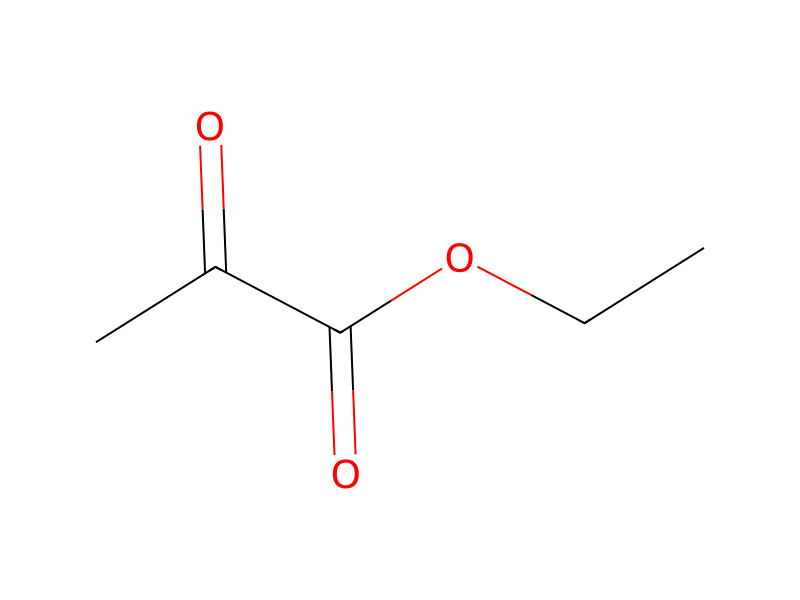
Ethyl pyruvate → HCID 73677025, compound
Reaction equation

Cl.[CH2:2]([NH:9][NH2:10])[CH2:3][CH2:4][CH2:5][CH2:6][CH2:7][CH3:8].[C:11]([O:16][CH2:17][CH3:18])(=[O:15])[C:12]([CH3:14])=O>C(O)C>[CH2:2]([NH:9][N:10]=[C:12]([CH3:14])[C:11]([O:16][CH2:17][CH3:18])=[O:15])[CH2:3][CH2:4][CH2:5][CH2:6][CH2:7][CH3:8]Participants
4
Reactant 2

Product 1

Reagents, catalysts & solvents 1

Procedure
4.0 g. Heptylhydrazine hydrochloride are dissolved in 40 ml. ethanol and 2.3 g. ethyl pyruvate added thereto. The solution is left to stand for 20 minutes at ambient temperature, then mixed with 160 ml. water and the oil which separates out is extracted with diethyl ether. The ethereal solution is washed several times with a 2 N aqueous sodium carbonate solution and then with water, dried over anhydrous sodium sulphate and evaporated. The ethyl 2-(heptylhydrazono)-propionate obtained as residue does not crystallize. The yield is 3.7 g. (82.4% of theory).
Workup
- waitThe solution is left
- additionmixed with 160 ml
- extractionwater and the oil which separates out is extracted with diethyl ether
- washThe ethereal solution is washed several times with a 2 N aqueous sodium carbonate solution
- dry with materialwith water, dried over anhydrous sodium sulphate
- customevaporated
Sources & evidence
- ORD record
- ord-f8ab0126bd3649989bf836642af7c21c
- Source dataset
- uspto-grants-1980_06
- Patent number
- US04206231
Reaction notes
Loading…