Hydrochloric Acid → 1,1-Bis(4-hydroxyphenyl)cyclohexane
Reaction equation
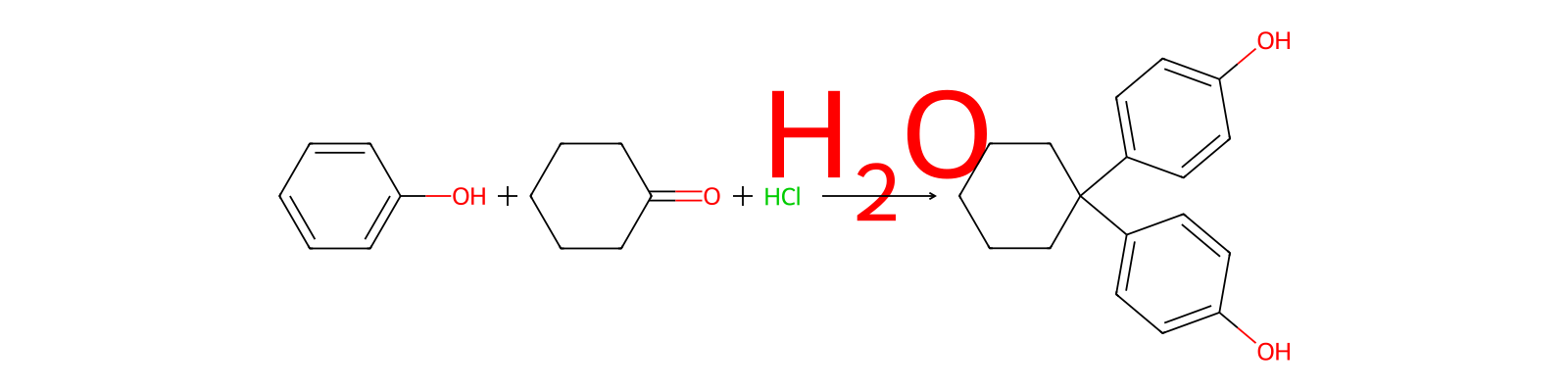
[C:1]1([OH:7])[CH:6]=[CH:5][CH:4]=[CH:3][CH:2]=1.[C:8]1(=[O:14])[CH2:13][CH2:12][CH2:11][CH2:10][CH2:9]1.Cl>O>[OH:7][C:1]1[CH:6]=[CH:5][C:4]([C:1]2([C:11]3[CH:12]=[CH:13][C:8]([OH:14])=[CH:9][CH:10]=3)[CH2:6][CH2:5][CH2:4][CH2:3][CH2:2]2)=[CH:3][CH:2]=1Participants
5
Reactant 3



Product 1

Reagents, catalysts & solvents 1

Conditions
- Temperature
- 36 °C
Procedure
A mixture of 188 g (2 moles) of phenol, 98 g (1 mole) of cyclohexanone and 32 g of concentrated hydrochloric acid was heated at 36° C. with stirring for 72 hours. At the end of this time water (1000 ml) was added to the solid red mass and the mixture was extracted with ether (3000 ml). The ethereal extract was washed with water and dried over anhydrous magnesium sulfate. The dried extract was filtered and the filtrate was evaporated to dryness. The residue was recrystallized from monochlorobenzene to give 75.4 g (53 percent theoretical yield) of 1,1-bis(p-hydroxyphenyl)cyclohexane in the form of a crystalline solid having a melting point of 181° to 182.5° C.
Workup
- extractionthe mixture was extracted with ether (3000 ml)
- extractionThe ethereal extract
- washwas washed with water
- dry with materialdried over anhydrous magnesium sulfate
- extractionThe dried extract
- filtrationwas filtered
- customthe filtrate was evaporated to dryness
- customThe residue was recrystallized from monochlorobenzene
Sources & evidence
- ORD record
- ord-9f75641b168d4005ba4a301b1ef0b0c5
- Source dataset
- uspto-grants-1980_06
- Patent number
- US04207265
Reaction notes
Loading…