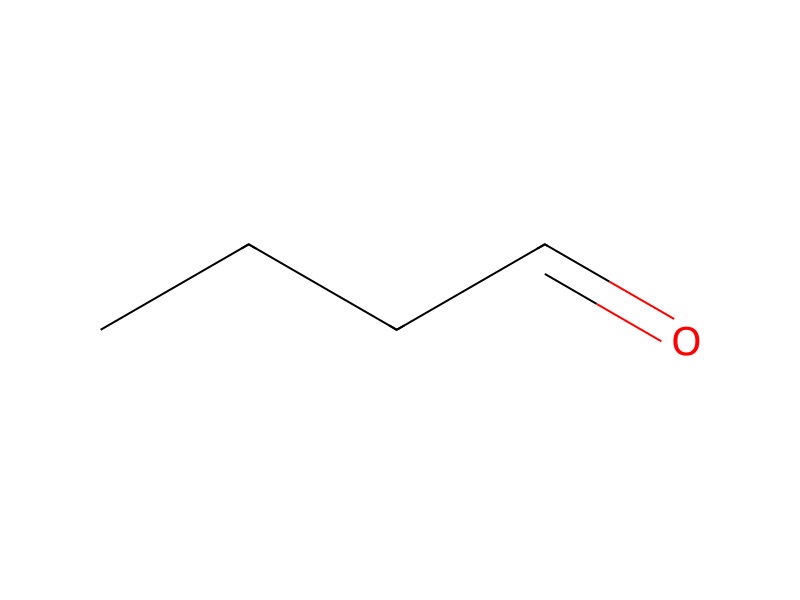
Butanal → 1,1-Dibutoxybutane
Reaction equation

[CH2:1]([OH:5])[CH2:2][CH2:3][CH3:4].[C:6]1([CH3:16])[CH:11]=[CH:10]C(S(O)(=O)=O)=CC=1.[CH:17](=[O:21])[CH2:18][CH2:19][CH3:20].[OH-].[Na+]>O.C1CCCCC1>[CH2:1]([O:5][CH:17]([O:21][CH2:10][CH2:11][CH2:6][CH3:16])[CH2:18][CH2:19][CH3:20])[CH2:2][CH2:3][CH3:4]Participants
Reactant 4



Product 1

Reagents, catalysts & solvents 2


Procedure
889.5 g of n-butanol, 1500 g of cyclohexane, and 5.7 g of p-toluenesulfonic acid are placed in a 4 liter three-necked flask fitted with a stirrer, dropping funnel, reflux condenser, and internal thermometer. 432.7 g of n-butyraldehyde is added with stirring over a period of 5 minutes. Owing to the acetal formation which starts spontaneously, the internal temperature rises to about 35° C. The mixture is allowed to react at 35° C. to 40° C. for 30 minutes, a Ph of 7.0 is then established in the reaction mixture, which is composed of a lower water phase and an upper organic phase, by addition of sodium hydroxide solution (20% aqueous solution), and the water phase is separated. To remove the low-boiling components, the organic phase is subjected to initial distillation at 200 mbar and a bottom temperature up to 160° C.
Workup
- customfitted with a stirrer
- temperaturereflux condenser
- customrises to about 35° C
- customto react at 35° C. to 40° C. for 30 minutes
- customthe water phase is separated
- customTo remove the low-boiling components
- distillationdistillation at 200 mbar
- customup to 160° C.
Sources & evidence
- ORD record
- ord-521fc2617ab14474a362765b2174014f
- Source dataset
- uspto-grants-1994_10
- Patent number
- US05354911
Reaction notes
Loading…