1-Octanol → Octyl [3-(trifluoromethyl)phenyl]acetate
Reaction equation
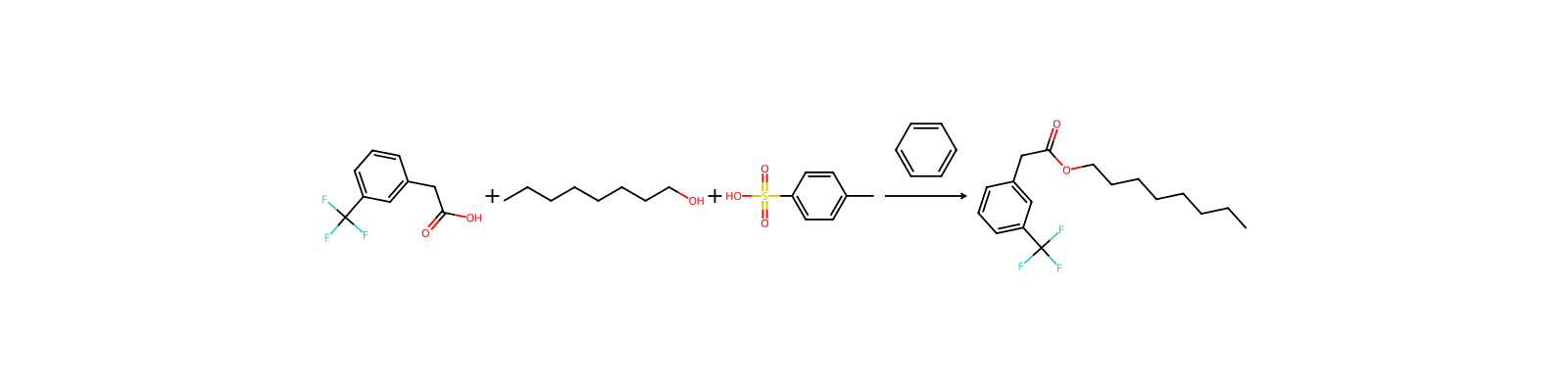
[F:1][C:2]([F:14])([F:13])[C:3]1[CH:4]=[C:5]([CH2:9][C:10]([OH:12])=[O:11])[CH:6]=[CH:7][CH:8]=1.[CH2:15](O)[CH2:16][CH2:17][CH2:18][CH2:19][CH2:20][CH2:21][CH3:22].C1(C)C=CC(S(O)(=O)=O)=CC=1>C1C=CC=CC=1>[F:1][C:2]([F:13])([F:14])[C:3]1[CH:4]=[C:5]([CH2:9][C:10]([O:12][CH2:15][CH2:16][CH2:17][CH2:18][CH2:19][CH2:20][CH2:21][CH3:22])=[O:11])[CH:6]=[CH:7][CH:8]=1Participants
5
Reactant 3



Product 1

Reagents, catalysts & solvents 1

Procedure
A mixture of 3-trifluoromethylphenylacetic acid (150.0 g), n-octanol (130.0 g), p-toluenesulphonic acid (9.5 g) and benzene (800 ml) is refluxed for 7 hours with a Dean-Stark separator. The solution is washed with a 10% aqueous solution of sodium carbonate (3×500 ml) and with water (3×500 ml). After drying over magnesium sulphate, the solvent is evaporated in vacuo. The residue is distilled (95°-97°/2.10-2Torr) to yield n-octyl 3-trifluoromethylphenylacetate.
Workup
- temperatureis refluxed for 7 hours with a Dean-Stark separator
- washThe solution is washed with a 10% aqueous solution of sodium carbonate (3×500 ml) and with water (3×500 ml)
- dry with materialAfter drying over magnesium sulphate
- customthe solvent is evaporated in vacuo
- distillationThe residue is distilled (95°-97°/2.10-2Torr)
Sources & evidence
- ORD record
- ord-29da05df62fd42f69000922a6cf0b86e
- Source dataset
- uspto-grants-1990_08
- Patent number
- US04946861
Reaction notes
Loading…