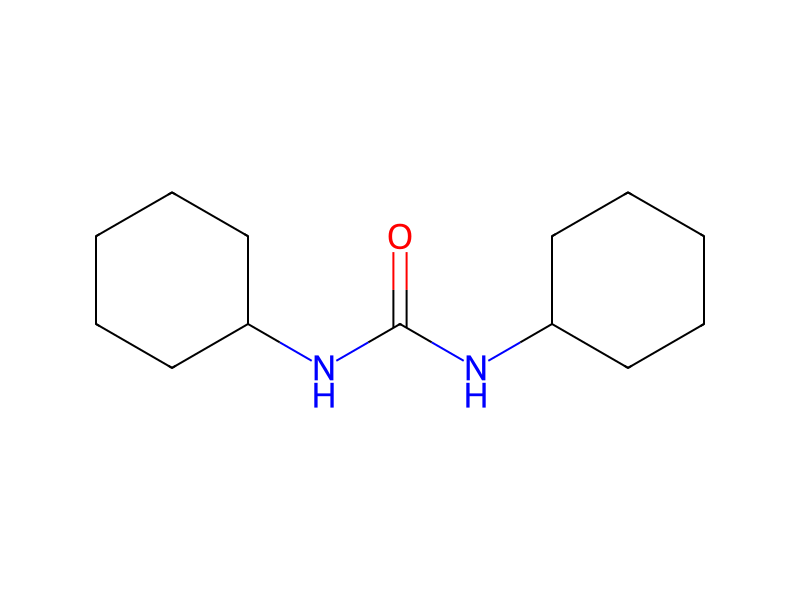
Dicyclohexylcarbodiimide → N,N'-Dicyclohexylurea
Reaction equation

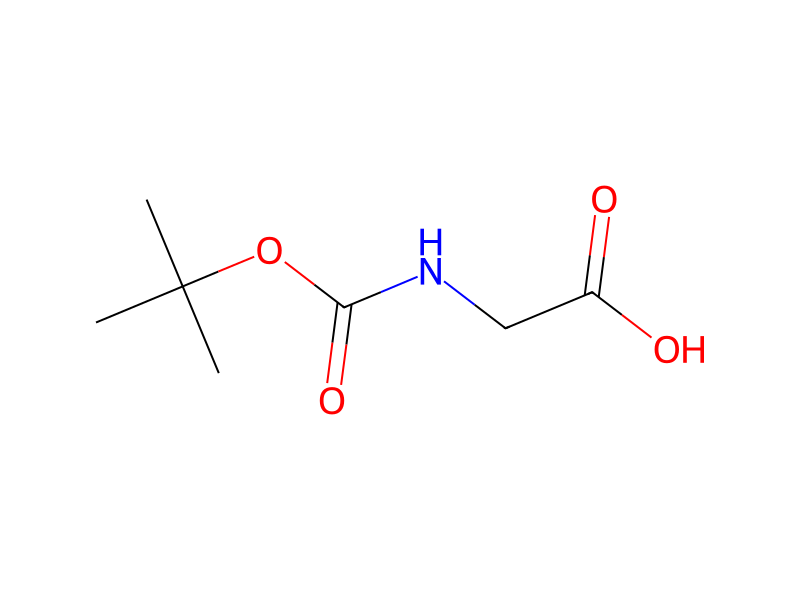
C([O:5]C(NCC(O)=O)=O)(C)(C)C.[CH:13]1([N:19]=[C:20]=[N:21][CH:22]2[CH2:27][CH2:26][CH2:25][CH2:24][CH2:23]2)[CH2:18][CH2:17][CH2:16][CH2:15][CH2:14]1>C(#N)C>[C:20]([NH:19][CH:13]1[CH2:14][CH2:15][CH2:16][CH2:17][CH2:18]1)([NH:21][CH:22]1[CH2:27][CH2:26][CH2:25][CH2:24][CH2:23]1)=[O:5]Participants
Reactant 2

Product 1
Reagents, catalysts & solvents 1

Procedure
To a solution of 9.45 g of N-(t-butoxycarbonyl)-glycine in 60 ml of acetonitrile was added 6.13 g of dicyclohexylcarbodiimide with stirring under ice-cooling. After three hours, dicyclohexylurea produced was filtered off, and the filtrate was concentrated. The oily residue was dissolved in 15 ml of anhydrous pyridine, and to the solution was added 5.00 g of 3'-O-(4-chlorobenzyl)-2'-deoxy-5-fluorouridine. The mixture was left to stand for three hours at room temperature and for 30 minutes at a temperature of 40° C. To the mixture was added 5 ml of water at room temperature and the mixture was left to stand for 30 minutes and then concentrated. The residue was dissolved in 50 ml of ethyl acetate, and the solution was washed three times with saturated aqueous solution of sodium hydrogen carbonate and twice with saturated aqueous solution of sodium chloride. Further the solution was dried over anhydrous magnesium sulfate and concentrated. The residue was placed on silica gel column and eluted with 1% methanol-chloroform, giving 5.33 g (75%) of 5'-O-[N-(t-butoxycarbonyl)glycyl]-3'-O-(4-chlorobenzyl)-2'-deoxy-5-fluorouridine.
Workup
- temperaturecooling
Sources & evidence
- ORD record
- ord-7a2a753fe71843eabf8b3ee942a9921b
- Source dataset
- uspto-grants-1990_08
- Patent number
- US04946951
Reaction notes
Loading…