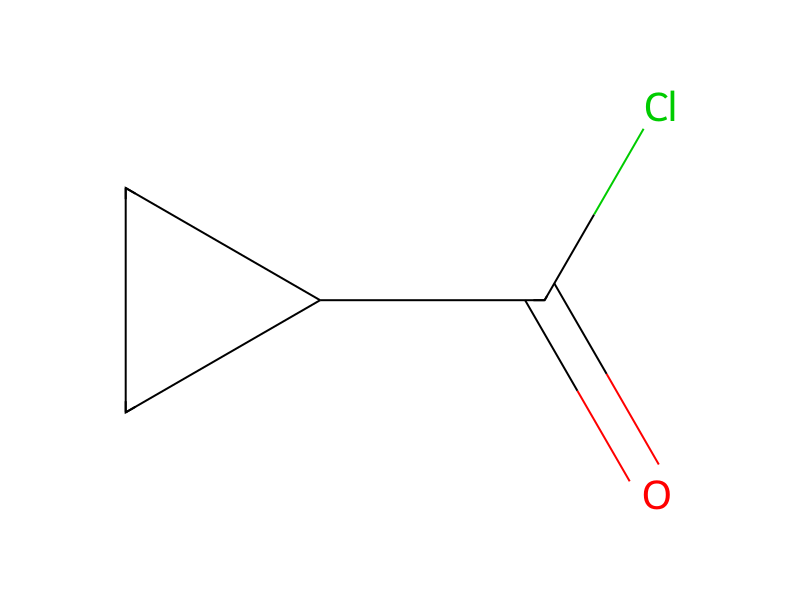
Cyclopropanecarbonyl chloride → HCID 16070221, compound
Reaction equation

[CH:1]1([C:4](Cl)=[O:5])[CH2:3][CH2:2]1.[O:7]1[CH:11]=[CH:10][CH:9]=[C:8]1[C:12]1[N:17]=[C:16]([NH2:18])[CH:15]=[N:14][C:13]=1[C:19]1[CH:24]=[CH:23][N:22]=[C:21]([CH3:25])[N:20]=1>N1C=CC=CC=1>[O:7]1[CH:11]=[CH:10][CH:9]=[C:8]1[C:12]1[N:17]=[C:16]([NH:18][C:4]([CH:1]2[CH2:3][CH2:2]2)=[O:5])[CH:15]=[N:14][C:13]=1[C:19]1[CH:24]=[CH:23][N:22]=[C:21]([CH3:25])[N:20]=1Participants
4
Reactant 2

Product 1

Reagents, catalysts & solvents 1

Conditions
- Temperature
- 80 °C
Procedure
Cyclopropanecarbonyl chloride (0.028 mL, 0.30 mmol) was added to a stirred solution of 6-(2-furyl)-5-(2-methylpyrimidin-4-yl)pyrazin-2-amine (Example 9, 38 mg, 0.15 mmol) in pyridine (0.5 mL). The mixture was heated to 80° C. in a sealed tube and stirred for 3 h. The crude reaction was concentrated to dryness and the residue was diluted with ethyl acetate and washed with aqueous sodium bicarbonate 4%. The organic layer was dried (Na2SO4) and evaporated. The residue was purified with flash silica gel chromatography (30% ethyl acetate in hexanes). Concentration in vacuo of the product-rich fractions provided the titled compound as a pale-yellow solid (12 mg, 25%).
Workup
- customThe crude reaction
- concentrationwas concentrated to dryness
- additionthe residue was diluted with ethyl acetate
- washwashed with aqueous sodium bicarbonate 4%
- dry with materialThe organic layer was dried (Na2SO4)
- customevaporated
- customThe residue was purified with flash silica gel chromatography (30% ethyl acetate in hexanes)
- concentrationConcentration in vacuo of the product-rich fractions
Sources & evidence
- ORD record
- ord-8b486725ba7540588476d178ac252cf0
- Source dataset
- uspto-grants-2010_09
- Patent number
- US07790728B2
Reaction notes
Loading…