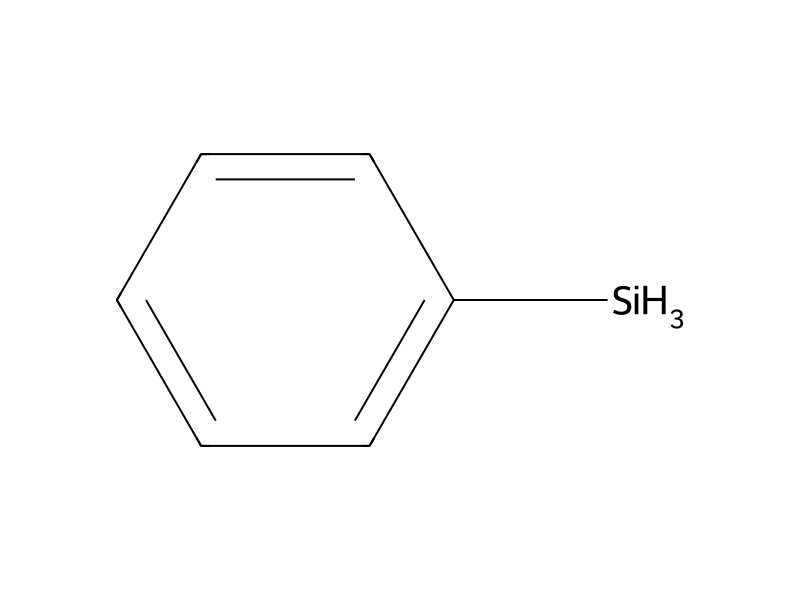
Phenylsilane → HCID 67237075, compound
Reaction equation

C1([SiH3])C=CC=CC=1.[C:8]([C:11]1[CH:16]=[CH:15][C:14](/[C:17](/[CH3:22])=[CH:18]/[N+:19]([O-:21])=[O:20])=[CH:13][CH:12]=1)(=[O:10])[CH3:9].[F-].C([N+](CCCC)(CCCC)CCCC)CCC>CC(C)([O-])C.[Cu+].C1(C)C=CC=CC=1.C[C@H](P(C1CCCCC1)C1CCCCC1)[C]1[C](P(C2C=CC=CC=2)C2C=CC=CC=2)[CH][CH][CH]1.[CH]1[CH][CH][CH][CH]1.[Fe].O.O1CCCC1>[C:8]([C:11]1[CH:16]=[CH:15][C:14]([CH:17]([CH3:22])[CH2:18][N+:19]([O-:21])=[O:20])=[CH:13][CH:12]=1)(=[O:10])[CH3:9]Participants
Reactant 3


Product 1

Reagents, catalysts & solvents 5





Procedure
In a 10 mL Schlenk-flask, 6.8 mg of copper (I) tert-butoxide and 55 μmol of (S)—(R)-JOSIPHOS were dissolved in 5 ml of toluene. After stirring for 30 minutes at room temperature to give an asymmetric copper complex. This solution to the amount containing 10 μmol of the asymmetric copper complex were mixed with 4.9 ml of toluene. Further, 185 μL of (1.5 mmol) of phenylsilane and 27 μL (1.5 mmol) of water were added thereto. After stirring for 5 minutes, 1 mmol of (E)-2-(4-acetylphenyl)-1-nitro-1-propene was added, and the mixture was further stirred for 24 hours at room temperature. Four milliliters (4 mL) of a tetrahydrofuran solution of tetrabutylammonium fluoride (1 mol/L) were added to the reaction mixture and stirring was continued for 3 hours. Water was added and the mixture was extracted with diethyl ether (30 mL×2). After drying over sodium sulfate, the solvent was evaporated. The residue was purified by flash chromatography (silica gel, hexane/ethyl acetate) to provide optically active 2-(4-acetylphenyl)-1-nitropropane.
Workup
- customto give an asymmetric copper complex
- additionThis solution to the amount containing 10 μmol of the asymmetric copper complex
- stirringAfter stirring for 5 minutes
- stirringthe mixture was further stirred for 24 hours at room temperature
- stirringstirring
- waitwas continued for 3 hours
- extractionthe mixture was extracted with diethyl ether (30 mL×2)
- dry with materialAfter drying over sodium sulfate
- customthe solvent was evaporated
- customThe residue was purified by flash chromatography (silica gel, hexane/ethyl acetate)
Sources & evidence
- ORD record
- ord-b5fb32c91a004cf785903a318ad1b4cc
- Source dataset
- uspto-grants-2010_09
- Patent number
- US07790900B2
Reaction notes
Loading…