(2S)-1,1,2-Triphenyl-1,2-ethanediol → Esomeprazole
Reaction equation

[CH3:1][C:2]1[C:7]([O:8][CH3:9])=[C:6]([CH3:10])[C:5]([CH2:11][S:12]([C:14]2[N-:18][C:17]3[CH:19]=[CH:20][C:21]([O:23][CH3:24])=[CH:22][C:16]=3[N:15]=2)=[O:13])=[N:4][CH:3]=1.O.[Na+].C1(C(C2C=CC=CC=2)(O)[C@H](C2C=CC=CC=2)O)C=CC=CC=1>O>[CH3:1][C:2]1[C:7]([O:8][CH3:9])=[C:6]([CH3:10])[C:5]([CH2:11][S@@:12]([C:14]2[NH:15][C:16]3[CH:22]=[C:21]([O:23][CH3:24])[CH:20]=[CH:19][C:17]=3[N:18]=2)=[O:13])=[N:4][CH:3]=1Participants
4
Reactant 2


Product 1
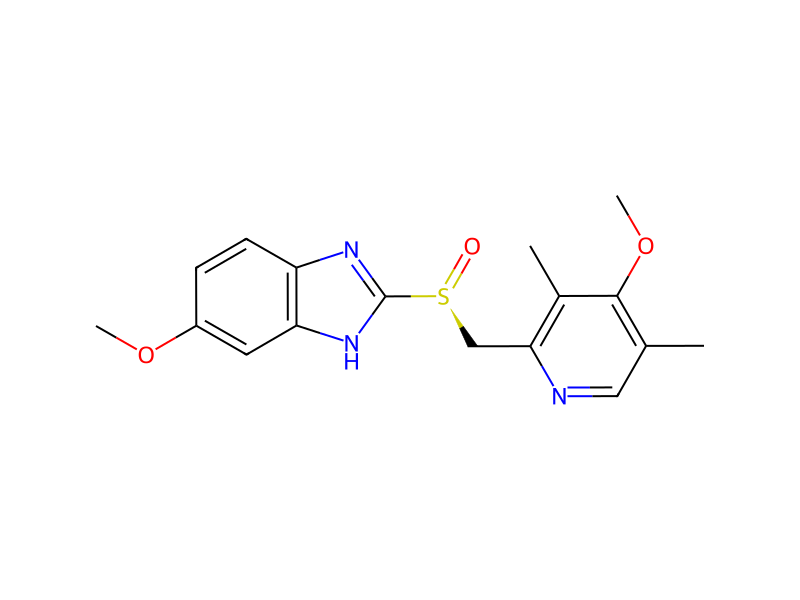
Reagents, catalysts & solvents 1

Procedure
The formation of the inclusion complex can also be carried out from an aqueous solution of omeprazole sodium salt in the presence of a water-miscible solvent and (S)-1,1,2-triphenyl-1,2-ethanediol. Neutralisation with acid results in the formation of a suspension of the same inclusion complex (S)-omeprazole.2[(S)-1,1,2-triphenyl-1,2-ethanediol] which is isolated by filtration.
Sources & evidence
- ORD record
- ord-9e42aea90efb4e7eb8f3d9f1f9070caf
- Source dataset
- uspto-grants-2010_09
- Patent number
- US07799925B2
Reaction notes
Loading…