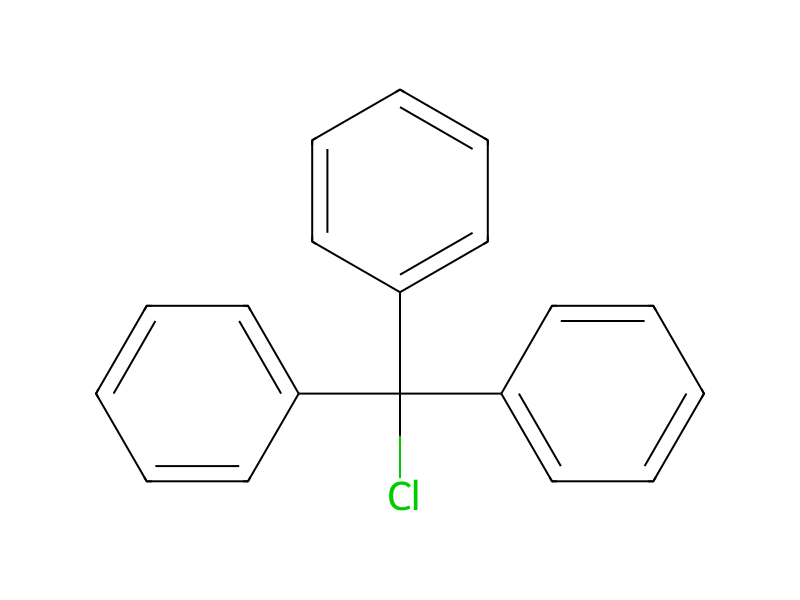
Trityl chloride → HCID 20267913, compound
Reaction equation

[OH:1][CH2:2][CH2:3][N:4]1[CH2:9][CH2:8][NH:7][CH2:6][CH2:5]1.[C:10](Cl)([C:23]1[CH:28]=[CH:27][CH:26]=[CH:25][CH:24]=1)([C:17]1[CH:22]=[CH:21][CH:20]=[CH:19][CH:18]=1)[C:11]1[CH:16]=[CH:15][CH:14]=[CH:13][CH:12]=1>C(Cl)Cl.CN(C)C>[OH:1][CH2:2][CH2:3][N:4]1[CH2:9][CH2:8][N:7]([C:10]([C:11]2[CH:16]=[CH:15][CH:14]=[CH:13][CH:12]=2)([C:23]2[CH:24]=[CH:25][CH:26]=[CH:27][CH:28]=2)[C:17]2[CH:18]=[CH:19][CH:20]=[CH:21][CH:22]=2)[CH2:6][CH2:5]1Participants
5
Reactant 2

Product 1

Reagents, catalysts & solvents 2


Procedure
2.6 g of 1-(2-hydroxyethyl)piperazine was dissolved in a mixture of 20 ml of dry methylene chloride and 10 ml of trimethylamine and stirred at room temperature during the slow addition of a solution of 5.6 g of trityl chloride in 20 ml of dry methylene chloride. When the addition was complete, the solution was stirred for a further 18 hours at room temperature and then evaporated to dryness. Basification with 5% aqueous sodium bicarbonate solution and extraction with methylene chloride gave 4.0 g of 1-(2-hydroxyethyl)-4-triphenylmethylpiperazine, m.p. 82°, used directly in the next stage.
Workup
- additionWhen the addition
- customevaporated to dryness
- extractionBasification with 5% aqueous sodium bicarbonate solution and extraction with methylene chloride
Sources & evidence
- ORD record
- ord-3b64c2d4ad6f4d9e9ffb6c0ed9b94153
- Source dataset
- uspto-grants-1985_09
- Patent number
- US04539322
Reaction notes
Loading…