Triphenylphosphine → HCID 11140657, compound
Reaction equation

[Br-].C1([PH+](C2C=CC=CC=2)C2C=CC=CC=2)C=CC=CC=1.[Br:21][CH2:22][CH2:23][CH:24]=[CH:25][CH2:26][CH:27]=[CH:28][CH2:29][CH:30]=[CH:31][CH2:32][CH2:33][CH2:34][CH2:35][CH3:36].C1(P(C2C=CC=CC=2)C2C=CC=CC=2)C=CC=CC=1>C(#N)C>[Br:21][CH2:22][CH2:23]/[CH:24]=[CH:25]\[CH2:26]/[CH:27]=[CH:28]\[CH2:29]/[CH:30]=[CH:31]\[CH2:32][CH2:33][CH2:34][CH2:35][CH3:36]Participants
Reactant 3

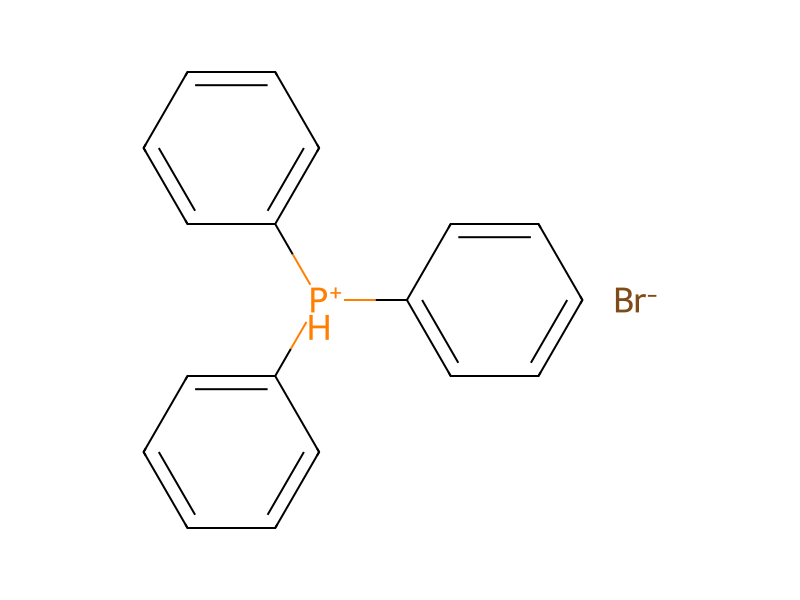

Product 1

Reagents, catalysts & solvents 1

Conditions
- Temperature
- 70 °C
Procedure
(3Z,6Z,9Z)-3,6,9,-Pentadecatrieyl!triphenyl-phosphonium Bromide. Bromo-3,6,9-pentadecatriene (7.0 g, 24.6 mmol) was treated with 7.5 g (28.6 mmol) of triphenylphosphine in 25 mL of acetonitrile. The mixture was heated to 70° C. under nitrogen atmosphere. Following reaction completion (monitor salt formation by TLC; 72 hours) the mixture was dried for 36 hours under reduced pressure to ensure removal of traces of acetonitrile. The resultant yellow residue, 13.45 g, was used in the next reaction without further purification: IR (neat, cm-1) 3010, 2958, 1652, 1191, 723; 1H NMR (CDCl3) δ 7.93-7.61 (m, 15 H), 5.69-5.12 (m, 6H), 4.02-3.91 (m, 2H), 2.69-2.48 (m, 4H), 2.09-1.92 (m, 2H), 1.89-1.72 (m, 2H), 1.46-1.25 (m, 6H), 0.88 (t, J=6.9 Hz, 3H).
Workup
- customreaction completion (monitor salt formation by TLC; 72 hours) the mixture
- customwas dried for 36 hours under reduced pressure
- customremoval of traces of acetonitrile
- customThe resultant yellow residue, 13.45 g, was used in the next reaction without further purification
Sources & evidence
- ORD record
- ord-f4fdda5015e74a26a45db8c5002fb21e
- Source dataset
- uspto-grants-1996_04
- Patent number
- US05504107
Reaction notes
Loading…