Acetone → Phenol
Reaction equation

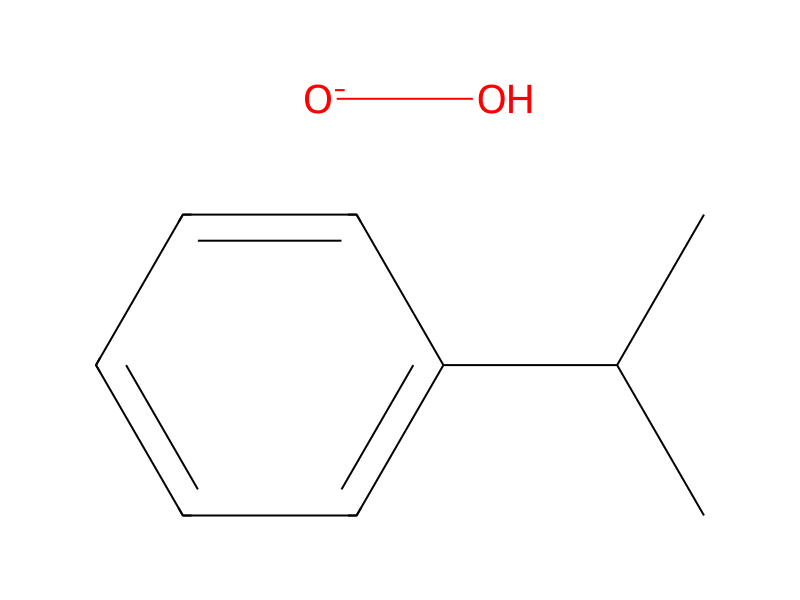
[C:1]1([OH:7])[CH:6]=[CH:5][CH:4]=[CH:3][CH:2]=1.[O-:8]O.[C:10]1([CH:16]([CH3:18])[CH3:17])[CH:15]=[CH:14][CH:13]=[CH:12][CH:11]=1.[CH3:19][C:20]([CH3:22])=[O:21]>>[C:1]1([OH:7])[CH:6]=[CH:5][CH:4]=[CH:3][CH:2]=1.[C:20]([O:21][O:8][C:16]([C:10]1[CH:15]=[CH:14][CH:13]=[CH:12][CH:11]=1)([CH3:18])[CH3:17])([C:1]1[CH:6]=[CH:5][CH:4]=[CH:3][CH:2]=1)([CH3:22])[CH3:19]Participants



Procedure
In another embodiment, a method for the production of phenol and acetone from a cumene hydroperoxide mixture comprises: a first stage and a second stage and at least two serially connected reactors, wherein the first stage comprises decomposition of a cumene hydroperoxide in the presence of a catalyst mixture to form phenol, acetone, and dicumyl peroxide mixture, and the second stage comprises formation of a phenol and acetone mixture from decomposition of the remainder of the cumene hydroperoxide and dicumyl peroxide formed in the first stage, wherein, the first stage further comprises: a) forming the catalyst mixture in a catalyst formation reactor by combining sulfuric acid and phenol in a weight ratio of from 2:1 to 1:1000, wherein the sulfuric acid is an aqueous sulfuric acid solution comprising at least 75 wt. % sulfuric acid; b) holding the catalyst mixture in the catalyst formation reactor at a temperature of about 35 to 45° C. for about 60 to 300 minutes; and c) adding the catalyst mixture to the cumene hydroperoxide mixture to form the phenol and acetone mixture, wherein the phenol and acetone mixture formed has a reduced level of hydroxyacetone as compared to a phenol and acetone mixture formed using a catalyst that is only sulfuric acid.
Sources & evidence
- ORD record
- ord-05ceaca6fe2844c1a0cb9b27cbce3ac6
- Source dataset
- uspto-grants-2009_02
- Patent number
- US07485758B2
Reaction notes
Loading…