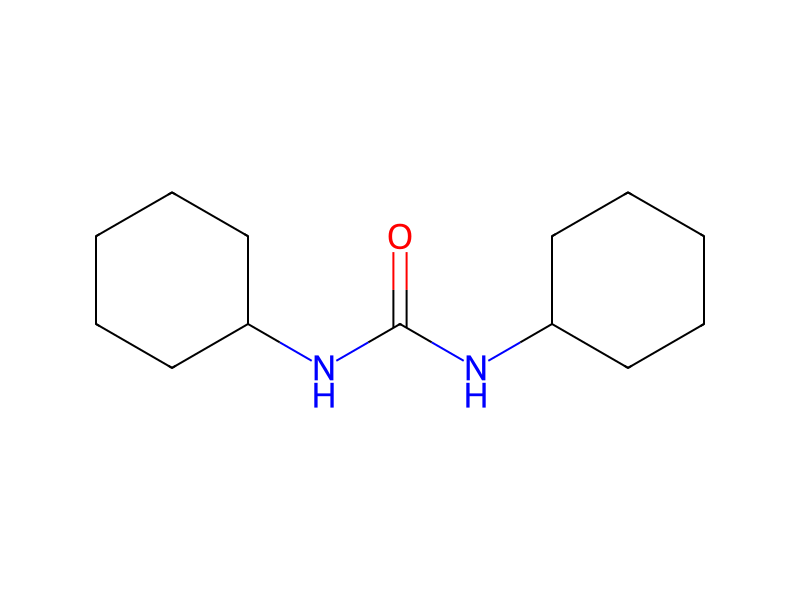
Dicyclohexylcarbodiimide → N,N'-Dicyclohexylurea
Reaction equation

C1C=CC2N([OH:10])N=NC=2C=1.[CH2:11]1[CH2:16][CH2:15][CH:14]([N:17]=[C:18]=[N:19][CH:20]2[CH2:25][CH2:24][CH2:23][CH2:22][CH2:21]2)[CH2:13][CH2:12]1>C1COCC1>[CH:20]1([NH:19][C:18](=[O:10])[NH:17][CH:14]2[CH2:13][CH2:12][CH2:11][CH2:16][CH2:15]2)[CH2:25][CH2:24][CH2:23][CH2:22][CH2:21]1Participants
Reactant 2


Product 1
Reagents, catalysts & solvents 1

Procedure
A mixture of 13 (52 mg, 0.058 mmol), HOBT (10 mg, 0.065 mmol) and DCC (16mg, 0.079 mmol) in THF (2 ml) was stirred for 1 hour at room temperature and filtered to remove resulting dicyclohexyl urea. The filtrate was concentrated and the residue was dissolved in 1 ml of 50% aqueous dioxane. To the mixture was added a solution of D-3,4-dihydroxyphenylalanine (D-DOPA) (24 mg, 0.12 mmol) and triethylamine (20 μl, 0.14 mmol) in 1 ml of 50% aqueous dioxane. The mixture was stirred for 1 day at room temperature and then dioxane was removed under reduced pressure. To the residue was added 50 ml of H2O and the mixture was acidified with 1N HC1 to pH 2. The precipitate formed was collected by filtration and chromatographed on a column of C-18 silica gel (Bondpak C18, 20 i.d. ×200 mm). The column was eluted with 30-40% acetonitrile-1/1000N HC1 and the desired fraction was concentrated and lyophilized to give 4'N-CBZ protected title compound (23 mg, yield 37%).
Workup
- filtrationfiltered
- customto remove
Sources & evidence
- ORD record
- ord-3558d22d2ddf4004aef55e8abbd42bc3
- Source dataset
- uspto-grants-1994_07
- Patent number
- US05326867
Reaction notes
Loading…