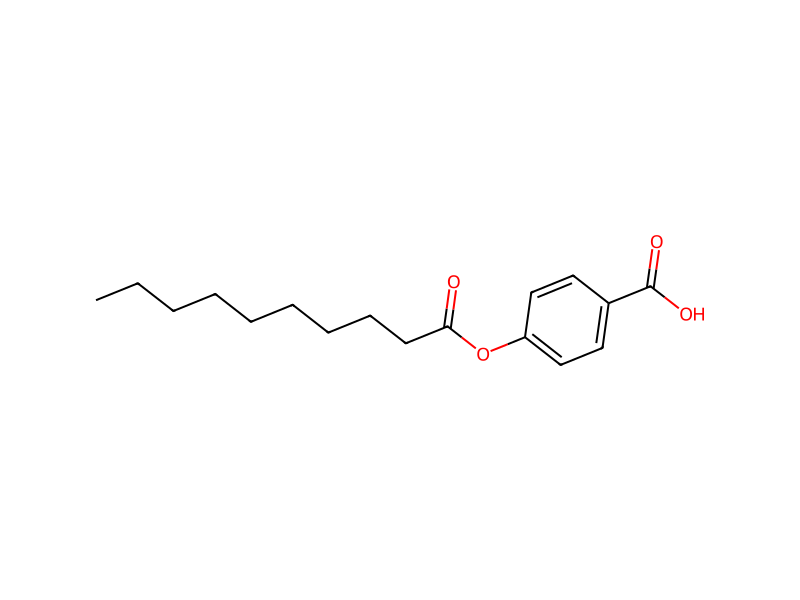
1,1,1-Trifluorooctan-2-YL 6-hydroxynaphthalene-2-carboxylate → Benzoic acid, 4-((1-oxodecyl)oxy)-
Reaction equation

OC1C=C2C(=CC=1)C=C(C(OC(CCCCCC)C(F)(F)F)=O)C=C2.FC1C=C(O)C=CC=1C(OC(CCCCCC)C(F)(F)F)=O.C(O[C:57]1[CH:62]=C[C:60]([C:63]2C=C[C:66]([C:69]([O:71][C:72]3[CH:77]=[CH:76][C:75]([C:78]([O:80]C(CCCCCC)C(F)(F)F)=[O:79])=[C:74](F)[CH:73]=3)=[O:70])=[CH:65][CH:64]=2)=[CH:59][CH:58]=1)CCCCCCC>O1CCCC1>[CH2:66]([C:69]([O:71][C:72]1[CH:77]=[CH:76][C:75]([C:78]([OH:80])=[O:79])=[CH:74][CH:73]=1)=[O:70])[CH2:65][CH2:64][CH2:63][CH2:60][CH2:59][CH2:58][CH2:57][CH3:62]Participants
Reactant 3


Product 1
Reagents, catalysts & solvents 1

Procedure
To a solution of the 1,1,1-trifluoro-2-octyl 6-hydroxynaphthalene-2-carboxylate (0.6 g) obtained in (1) above and the 4-n-nonylcarbonyloxybenzoic acid (0.45 g) obtained in (2) above in tetrahydrofuran (40 ml) were added dicyclohexylcarbodiimide (0.45 g) and dimethylaminopyridine (0.05 g). The solution was stirred overnight and distilled to remove the solvent. The residue was dissolved in dichloromethane (40 ml) and washed with dilute aqueous hydrochloric acid solution and water, in this order. The solution was dried over anhydrous magnesium sulfate and distilled to remove the solvent. The residue was purified by silica-gel column chromatography (developer: hexane/ethyl acetate=20/1) to obtain the titled compound (0.05 g) having specific rotation, [α]D20 =+42.86°.
Sources & evidence
- ORD record
- ord-bf0e1b7dd9604ca29b4be6f68913986c
- Source dataset
- uspto-grants-1994_07
- Patent number
- US05328641
Reaction notes
Loading…