Hydroquinone → 4-[2,2-Dimethyl-5-(4-methylphenyl)-3,4-dihydro-2H-pyrrol-3-yl]pyridine
Reaction equation

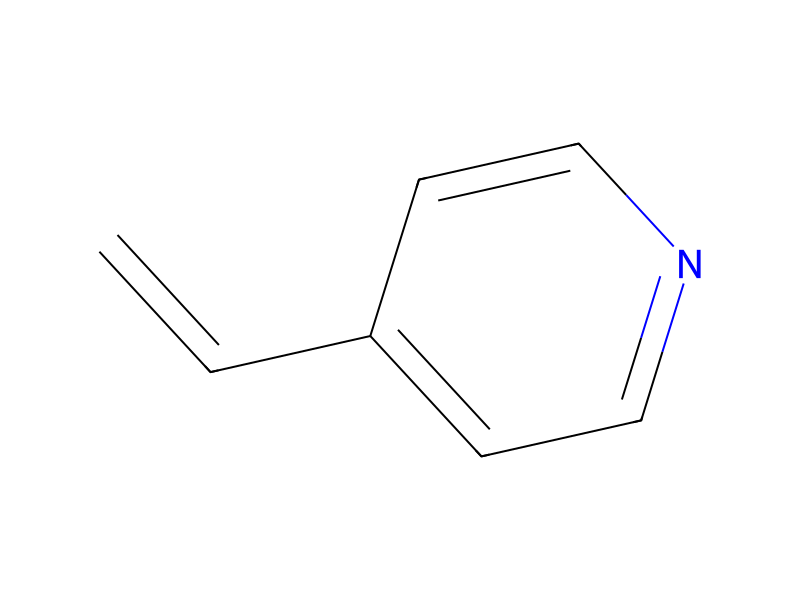
[CH3:1][C:2]1[CH:7]=[CH:6][C:5]([C:8]2[C:9]([CH3:12])([CH3:11])[N:10]=2)=[CH:4][CH:3]=1.[CH:13]([C:15]1[CH:20]=[CH:19][N:18]=[CH:17][CH:16]=1)=[CH2:14].C1C(O)=CC=C(O)C=1>C1C=CC=CC=1>[CH3:1][C:2]1[CH:3]=[CH:4][C:5]([C:8]2[CH2:14][CH:13]([C:15]3[CH:20]=[CH:19][N:18]=[CH:17][CH:16]=3)[C:9]([CH3:11])([CH3:12])[N:10]=2)=[CH:6][CH:7]=1Participants
Reactant 3


Product 1

Reagents, catalysts & solvents 1

Procedure
16 G. of 3-(p-methylphenyl)-2,2-dimethyl-2H-azirine and 26 g. of freshly distilled 4-vinylpyridine are irradiated in 2 l. of absolute benzene for 6 hours under the conditions given in Example 11 with the addition of 0.05 g. of p-hydroquinone. After evaporation of the solution under reduced pressure there remains a brown oil from which the excess 4-vinylpyridine is distilled off at 41°-42° C. and 0.01 Torr. The residue is taken up in a small amount of acetone. The crude crystallizate obtained from the acetone solution is chromatographed withe benzene/acetone (95:5) on silica gel. The combined fractions are evaporated to dryness under reduced pressure. Then, the residue is recrystallized twice with n-hexane, the solution which results is then decolorized with active carbon to yield 4-[2-(p-methylphenyl)-5,5-dimethyl-1-pyrrolin-4-yl]-pyridine with a melting point of 102° C.
Workup
- customAfter evaporation of the solution under reduced pressure
- distillationis distilled off at 41°-42° C.
- customThe crude crystallizate obtained from the acetone solution
- customis chromatographed withe benzene/acetone (95:5) on silica gel
- customThe combined fractions are evaporated to dryness under reduced pressure
- customThen, the residue is recrystallized twice with n-hexane
- customthe solution which results
Sources & evidence
- ORD record
- ord-8b05f0f991c341669bbb94f60c10ec61
- Source dataset
- uspto-grants-1976_11
- Patent number
- US03991197
Reaction notes
Loading…