Thionyl Chloride → 1,4-Diamino-2-chloroanthracene-9,10-dione
Reaction equation

S(Cl)([Cl:3])=O.[NH2:5][C:6]1[C:19]2[C:18](=[O:20])[C:17]3[C:12](=[CH:13][CH:14]=[CH:15][CH:16]=3)[C:11](=[O:21])[C:10]=2[C:9]([NH2:22])=[CH:8][CH:7]=1>>[Cl:3][C:8]1[CH:7]=[C:6]([NH2:5])[C:19]2[C:18](=[O:20])[C:17]3[C:12](=[CH:13][CH:14]=[CH:15][CH:16]=3)[C:11](=[O:21])[C:10]=2[C:9]=1[NH2:22]Participants
3


Procedure
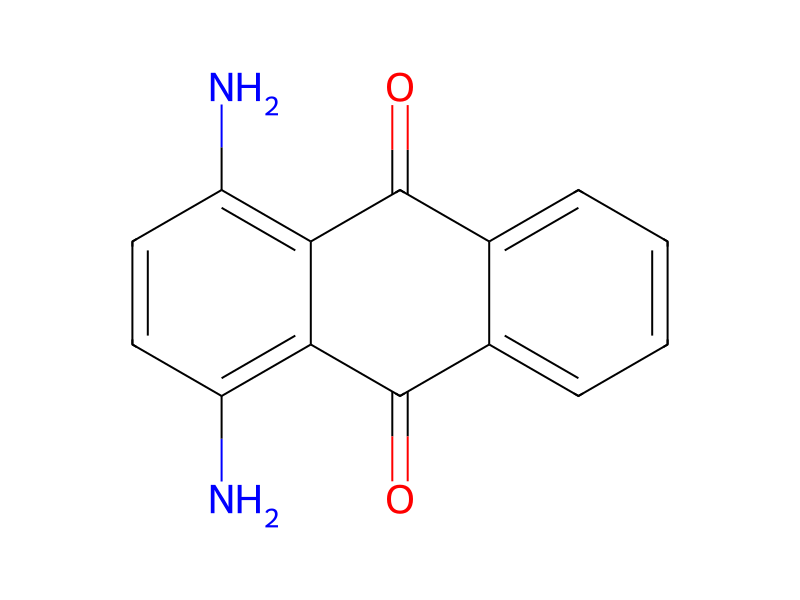
A mixture of thionyl chloride (320 g) and 1,4-diamino anthraquinone (20 g) is refluxed for 24 hours. The mixture is then cooled and poured onto crushed ice. The precipitate is filtered, dried and purified by recrystallization from carbon tetrachloride. The yield is 50 percent 2-chloro-1,4-diamino anthraquinone with a melting point of 207° C. to 210° C.
Workup
- temperatureis refluxed for 24 hours
- temperatureThe mixture is then cooled
- additionpoured
- customonto crushed ice
- filtrationThe precipitate is filtered
- customdried
- custompurified by recrystallization from carbon tetrachloride
Sources & evidence
- ORD record
- ord-8e52eff60e924f3faf3df838b33551cf
- Source dataset
- uspto-grants-1986_11
- Patent number
- US04622169
Reaction notes
Loading…