Potassium Carbonate → 2,3-Difluoro-5-(trifluoromethyl)pyridine
Reaction equation

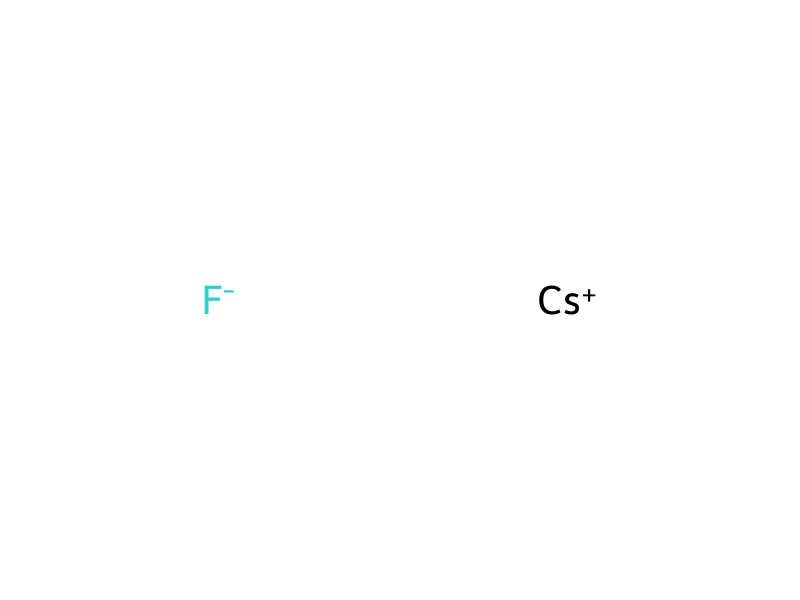
C([O-])([O-])=O.[K+].[K+].[F-:7].[Cs+].Cl[C:10]1[C:11]([F:20])=[N:12][CH:13]=[C:14]([C:16]([F:19])([F:18])[F:17])[CH:15]=1>CS(C)=O>[F:20][C:11]1[C:10]([F:7])=[CH:15][C:14]([C:16]([F:19])([F:18])[F:17])=[CH:13][N:12]=1Participants
Reactant 3


Product 1

Reagents, catalysts & solvents 1

Conditions
- Temperature
- 65 °C
Procedure
A 100 ml 4-neck round bottom flask, containing a magnetic stir bar and fitted with a thermometer, nitrogen inlet and distillation condenser, was charged with 75 ml of DMSO, 0.5 g of anhydrous K2CO3 and 22.8 g (0.15 mole) of CsF. The reaction mixture was heated to 115° C. at 57 mm Hg so that about 20 ml of DMSO was distilled to dry the reaction mixture. The light yellow reaction mixture was cooled to 65° C. and 20 g (0.1 mole) of 3-chloro-2-fluoro-5-(trifluoromethyl)pyridine was added through a pressure equalizing addition funnel which replaced the distillation condenser. After a dry ice condenser was attached to the flask the reaction temperature was maintained at 105°-115° C. for 46.5 hours with constant agitation. The reaction mixture was black with dark solids on the sides of the flask. A short path distillation condenser was attached to the flask and 13 g of crude product was collected in a receiver, which was cooled in a dry ice/acetone bath (pressure=210 mm Hg; temperature (overhead)=85°-130° C.; temperature (pot)=125°-160° C.). This crude product was extracted with water to remove any residual DMSO and dried over 4 Å molecular sieves (11.5 g crude product; 11 g crude product after drying). The product was then transferred to a 25 ml round bottom flask and distilled at 102° C. (uncorrected)/760 mm Hg through a Vigreaux® column resulting in 9.3 g of substantially pure 2,3-di-fluoro-5-(trifluoromethyl)pyridine. The isolated yield of desired product was calculated to be 48.4% of theoretical. The structure of the product was confirmed by its nuclear magnetic resonance (NMR) spectra. Elemental analysis results for the product were: Theoretical: C, 39.36; H, 1.09; N, 7.65; Cl, 0. Found: C, 38.44; H, 1.01; N, 7.79; Cl, 0.25.
Workup
- additionA 100 ml 4-neck round bottom flask, containing a magnetic stir bar
- customfitted with a thermometer, nitrogen inlet and distillation condenser
- distillationwas distilled
- customto dry the reaction mixture
- additionaddition funnel which
- customAfter a dry ice condenser was attached to the flask
- temperaturethe reaction temperature was maintained at 105°-115° C. for 46.5 hours with constant agitation
- distillationA short path distillation condenser
- customwas collected in a receiver, which
- temperaturewas cooled in a dry ice/acetone bath (pressure=210 mm Hg; temperature (overhead)=85°-130° C.; temperature (pot)=125°-160° C.)
- extractionThis crude product was extracted with water
- customto remove any residual DMSO
- dry with materialdried over 4 Å molecular sieves (11.5 g crude product; 11 g crude product after drying)
- customThe product was then transferred to a 25 ml round bottom flask
- distillationdistilled at 102° C. (uncorrected)/760 mm Hg through a Vigreaux® column
Sources & evidence
- ORD record
- ord-2af15538b74a414d9acc16433113ccef
- Source dataset
- uspto-grants-1986_11
- Patent number
- US04625035
Reaction notes
Loading…