Triethylamine → HCID 20300022, compound
Reaction equation

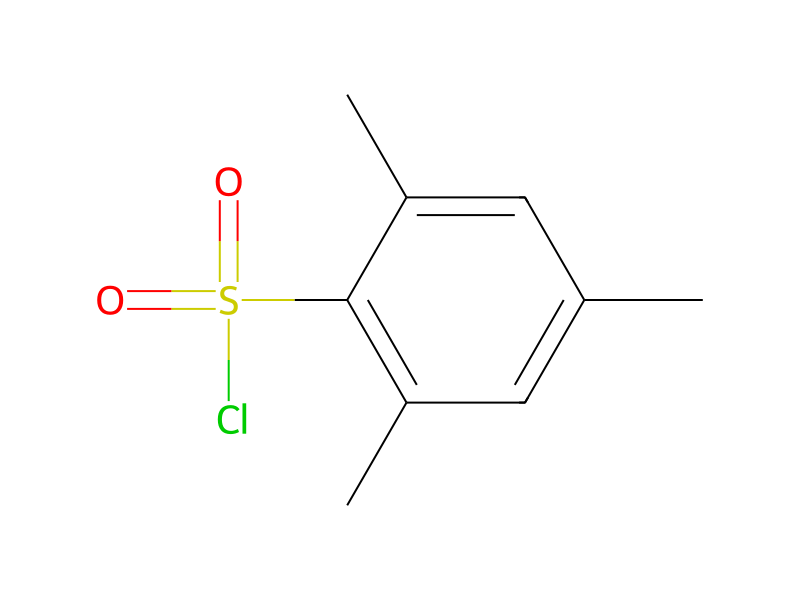
[OH:1][N:2]1[C:6]2[CH:7]=[CH:8][CH:9]=[CH:10][C:5]=2[N:4]=[N:3]1.C(N(CC)CC)C.[CH3:18][C:19]1[CH:24]=[C:23]([CH3:25])[CH:22]=[C:21]([CH3:26])[C:20]=1[S:27](Cl)(=[O:29])=[O:28]>ClCCl>[CH3:18][C:19]1[CH:24]=[C:23]([CH3:25])[CH:22]=[C:21]([CH3:26])[C:20]=1[S:27]([O:1][N:2]1[C:6]2[CH:7]=[CH:8][CH:9]=[CH:10][C:5]=2[N:4]=[N:3]1)(=[O:28])=[O:29]Participants
5
Reactant 3


Product 1

Reagents, catalysts & solvents 1

Procedure
In dichloromethane (70 ml) are added 1-hydroxy-1,2,3-benzotriazole (3.4 g) and further triethylamine (3.7 ml). To the solution is added dropwise a solution of 2,4,6-trimethylbenzenesulfonyl chloride (4.5 g) is dichloromethane (20 ml) at room temperature, and the mixture is stirred for 1 hour. The reaction mixture is washed with water and dried over anhydrous magnesium sulfate, and the solvent is distilled off. The resulting residue is washed with ethyl acetate-n-hexane (1:1; 50 ml) and dried to give colorless crystals of 1-(2,4,6-trimethylbenzenesulfonyloxy)-1,2,3-benzotriazole (5.5 g), melting point: 128°-130° C. The product is recrystallized from dichloromethane-n-hexane to give colorless prisms, melting point: 130°-131° C.
Workup
- customat room temperature
- washThe reaction mixture is washed with water
- dry with materialdried over anhydrous magnesium sulfate
- distillationthe solvent is distilled off
- washThe resulting residue is washed with ethyl acetate-n-hexane (1:1; 50 ml)
- customdried
Sources & evidence
- ORD record
- ord-cf986494ebd940faacf810ab76d16980
- Source dataset
- uspto-grants-1980_12
- Patent number
- US04242507
Reaction notes
Loading…