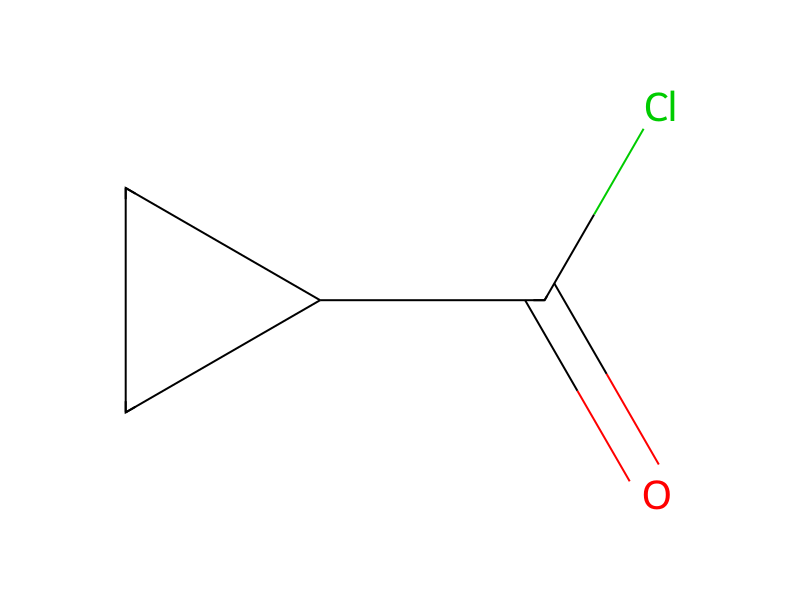
Cyclopropanecarbonyl chloride → 5-Cyclopropylcarbonylamino-3-isopropylisothiazole-4-carbonitrile
Reaction equation

[CH:1]1([C:4](Cl)=[O:5])[CH2:3][CH2:2]1.[NH2:7][C:8]1[S:12][N:11]=[C:10]([CH:13]([CH3:15])[CH3:14])[C:9]=1[C:16]#[N:17]>C1(C)C=CC=CC=1.N1C=CC=CC=1>[CH:1]1([C:4]([NH:7][C:8]2[S:12][N:11]=[C:10]([CH:13]([CH3:15])[CH3:14])[C:9]=2[C:16]#[N:17])=[O:5])[CH2:3][CH2:2]1Participants
5




Procedure
12.5 g of cyclopropanecarbonyl chloride in 30 ml of toluene are added dropwise to a solution of 16.7 g of 5-amino-4-cyano-3-isopropylisothiazole and about 0.5 g of DMAP (N,N-dimethylaminopyridine) in 200 ml of toluene and 200 ml of pyridine. The solution is stirred for 16 hours at room temperature and then evaporated to dryness, and the residue is taken up in ethyl acetate. The organic phase is extracted with aqueous sodium bicarbonate solution and 10% strength hydrochloric acid and is dried and evaporated down.
Workup
- customevaporated to dryness
- extractionThe organic phase is extracted with aqueous sodium bicarbonate solution and 10% strength hydrochloric acid
- customis dried
- customevaporated down
Sources & evidence
- ORD record
- ord-143848ac62f74fd2acd8cf73b494c02a
- Source dataset
- uspto-grants-1996_07
- Patent number
- US05538939
Reaction notes
Loading…