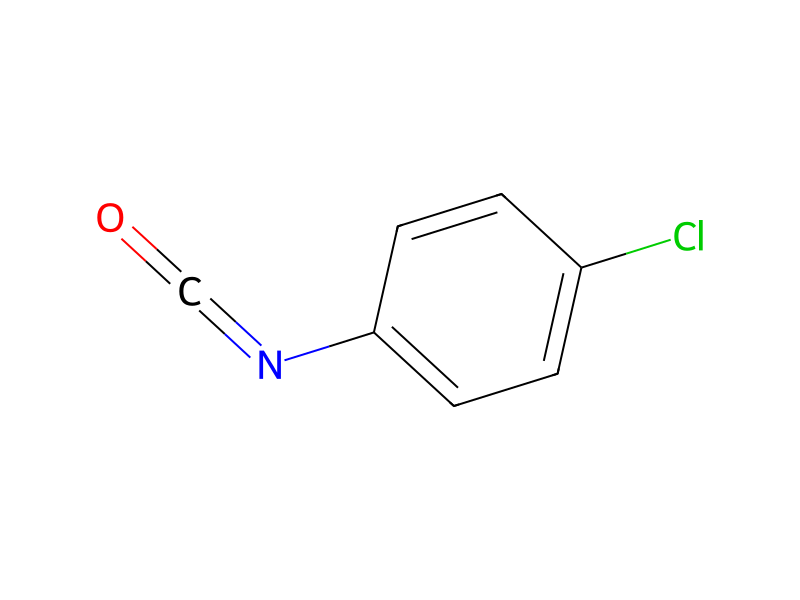
4-Chlorophenyl Isocyanate → HCID 3958937, compound
Reaction equation

[Cl:1][C:2]1[CH:7]=[CH:6][C:5]([N:8]=[C:9]=[O:10])=[CH:4][CH:3]=1.[C:11](OC)(=[O:19])[C:12]1[C:13](=[CH:15][CH:16]=[CH:17][CH:18]=1)[NH2:14].C(N(CC)CC)C>C1(C)C=CC=CC=1>[Cl:1][C:2]1[CH:7]=[CH:6][C:5]([N:8]2[C:11](=[O:19])[C:12]3[C:13](=[CH:15][CH:16]=[CH:17][CH:18]=3)[NH:14][C:9]2=[O:10])=[CH:4][CH:3]=1Participants
Reactant 3


Product 1

Reagents, catalysts & solvents 1

Conditions
- Temperature
- 90 °C
Procedure
A solution of p-chlorophenyl isocyanate (15.3 g, 0.10 mol) in toluene (50 ml) is metered at room temperature into a solution of methyl anthranilate (15.1 g, 0.10 mol) in toluene (100 ml). After addition is complete, the mixture is stirred at 90° C. for 2 hours. Triethylamine (1.4 ml, 1.0 g, 0.010 mol) is metered in and the mixture is stirred at 90° C. for a further 3 hours. After cooling, the product is filtered off with suction and washed with 3×20 ml of toluene and dried. 21.0 g of 3-(4-chlorophenyl)-2,4(1H,3H)-quinazolinedione (yield: 77.0% of theory) of melting point 288° to 290° C. are obtained. According to thin-layer chromatography, the product is contaminated with the intermediate ethyl N-(4-chlorophenylcarbamoyl)anthranilate.
Workup
- additionAfter addition
- stirringis stirred at 90° C. for a further 3 hours
- temperatureAfter cooling
- filtrationthe product is filtered off with suction
- washwashed with 3×20 ml of toluene
- customdried
Sources & evidence
- ORD record
- ord-265c9287a3304a77bfab229c0c9fa0ae
- Source dataset
- uspto-grants-1996_07
- Patent number
- US05539114
Reaction notes
Loading…