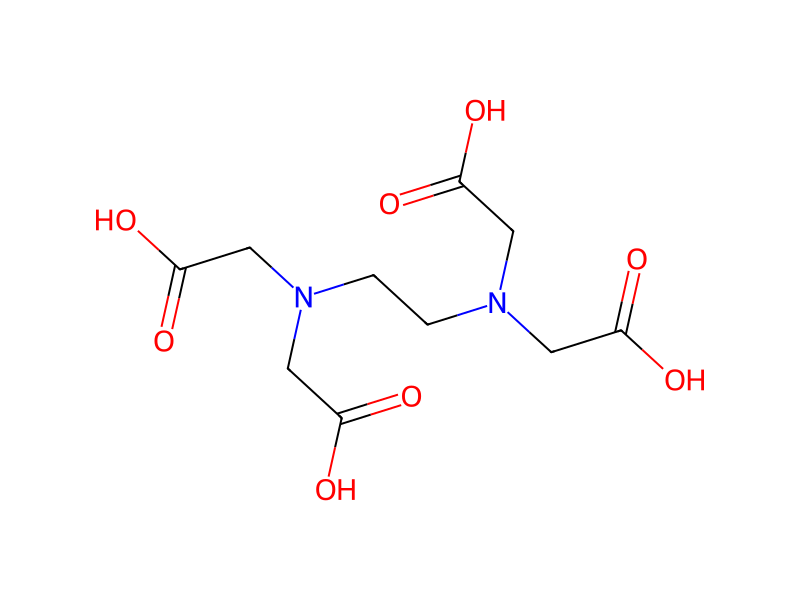
Ethylenediaminetetraacetic Acid → 5-Bromo-2-ethylpyridine
Reaction equation

[CH2:1]([Mg]Cl)[CH3:2].Br[C:6]1[CH:11]=[CH:10][C:9]([Br:12])=[CH:8][N:7]=1.C(N(CC(O)=O)CC(O)=O)CN(CC(O)=O)CC(O)=O.[Na][Na]>C1COCC1.O.[Cl-].[Zn+2].[Cl-]>[Br:12][C:9]1[CH:10]=[CH:11][C:6]([CH2:1][CH3:2])=[N:7][CH:8]=1Participants
Reactant 4


Product 1

Reagents, catalysts & solvents 3



Procedure
A solution of ethylmagnesium chloride (2M in diethyl ether, 21.1 ml, 42.2 mmol) was added to dry THF (75 ml) and then treated with zinc chloride solution (1.0M in diethyl ether, 42.2 ml, 42.2 mmol). The suspension was stirred for 30 minutes at room temperature and was then cooled in ice. Tetrakis-(triphenylphosphine)palladium(0) (0.5 g) was added to the suspension followed by a solution of 2,5-dibromopyridine (5.0 g, 21.1 mmol) in THF (25 ml). The mixture was stirred at 5° C. for 5 hours and then shaken with a suspension of ethylenediamine-tetraacetic acid, disodium salt dihydrate (7.9 g, 21 mmol) in water (100 ml). The layers were separated and the aqueous phase was extracted with dichloromethane (50 ml). The combined organic layers were dried (MgSO4) and evaporated under reduced pressure. The residue was distilled under reduced pressure (60 mm) at an oven temperature of 180° C. using a Kugelrohr (trade mark) apparatus to give the title compound, (2.25 g).
Workup
- temperaturewas then cooled in ice
- stirringThe mixture was stirred at 5° C. for 5 hours
- customThe layers were separated
- extractionthe aqueous phase was extracted with dichloromethane (50 ml)
- dry with materialThe combined organic layers were dried (MgSO4)
- customevaporated under reduced pressure
- distillationThe residue was distilled under reduced pressure (60 mm) at an oven temperature of 180° C.
Sources & evidence
- ORD record
- ord-58dcb8902ec34e4fafdb5e1f75af0991
- Source dataset
- uspto-grants-1996_07
- Patent number
- US05541203
Reaction notes
Loading…