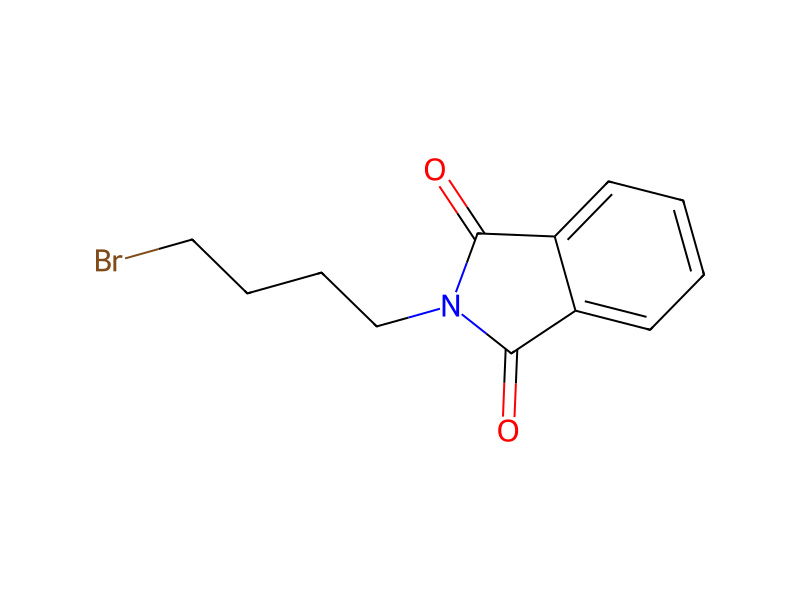
1,4-Dibromobutane → N-(4-Bromobutyl)phthalimide
Reaction equation

[C:1]1(=[O:11])[NH:5][C:4](=[O:6])[C:3]2=[CH:7][CH:8]=[CH:9][CH:10]=[C:2]12.[K].[Br:13][CH2:14][CH2:15][CH2:16][CH2:17]Br>CN(C=O)C>[Br:13][CH2:14][CH2:15][CH2:16][CH2:17][N:5]1[C:1](=[O:11])[C:2]2=[CH:10][CH:9]=[CH:8][CH:7]=[C:3]2[C:4]1=[O:6]Participants
4
Reactant 2


Product 1
Reagents, catalysts & solvents 1

Conditions
- Temperature
- 60 °C
Procedure
First, N-(4-bromobutyl)phthalimide is synthesized from a mixture of 30 mmol potassium phthalimide and 100 mmol 1,4 dibromobutane in 50 ml DMF. The solution is stirred for 2 hours at 60° C., and the DMF and 1,4-dibromobutane is evaporated off in vacuo. The remaining residue is extracted with CHCl3 and H2O. The resulting white compound is recrystallized from ethyl alcohol. See Chem. Pharm. Bull. 32:3428 (1984). ##STR2##
Workup
- customthe DMF and 1,4-dibromobutane is evaporated off in vacuo
- extractionThe remaining residue is extracted with CHCl3 and H2O
- customThe resulting white compound is recrystallized from ethyl alcohol
Sources & evidence
- ORD record
- ord-ae871a82b0ea4bd39c3476cd1ef30d69
- Source dataset
- uspto-grants-1996_07
- Patent number
- US05541230
Reaction notes
Loading…