Acetonitrile → Phenacyl bromide
Reaction equation

[CH3:1][C:2]([C:4]1[CH:9]=[CH:8][C:7](OCC2C=CC=CC=2)=[C:6]([N+]([O-])=O)[CH:5]=1)=[O:3].C(C1C=CC=CC=1)(=O)C.[Br:30]Br.CC#N>C(Cl)(Cl)Cl.CO>[Br:30][CH2:1][C:2]([C:4]1[CH:9]=[CH:8][CH:7]=[CH:6][CH:5]=1)=[O:3]Participants
Reactant 4




Product 1
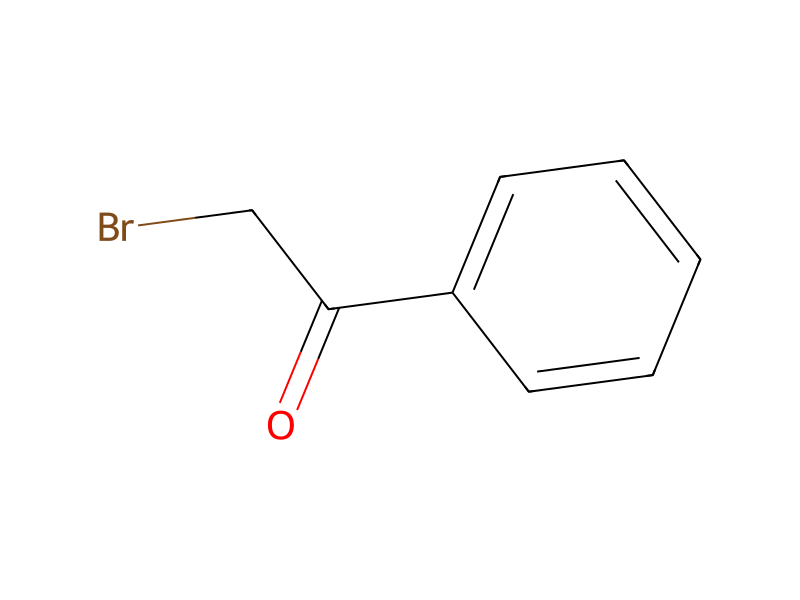
Reagents, catalysts & solvents 2


Procedure
The optically pure epoxide 1 is prepared from commercially available 4-benzyloxy-3-nitroacetophenone. Thus, the acetophenone may be brominated with bromine in an inert organic solvent such as CH3CN, MeOH or chloroform to give the α-bromoacetophenone. The bromoacetophenone is then reduced with a borane reducing agent such as BH3.THF or BH3.Me2S in the presence of a chiral oxazaborolidine catalyst to give the optically active bromohydrin by extraction from aqueous acid in excellent yield (>98%) and good enantiomeric excess (ee=95%). An example of such a catalyst is cis-(1R,2S)-aminoindanol-B-Me, or AIBMe, which is the product of the reaction between cis-(1R,2S)-aminoindanol and trimethylboroxine, according to the procedure described in U.S. Pat. No. 5,495,821. The bromohydrin can be further enriched to >99.8% ee by crystallization. The absolute configuration of the bromohydrin is determined by the chirality of the oxazaborolidine catalyst. The resulting compound is converted to optically pure 4-benzyloxy-3-nitrostyrene oxide with a base such as aq. NaOH or K2CO3 in an alcohol solvent or solvent mixture such as MeOH/THF. The epoxide can be isolated by extraction of the reaction mixture with ethyl acetate/water, drying the organic phase and evaporating the solvent.
Sources & evidence
- ORD record
- ord-5e615b4089424137bffd6f42aa97bf05
- Source dataset
- uspto-grants-1999_10
- Patent number
- US05965622
Reaction notes
Loading…