Acetic Acid → HCID 70059445, compound
Reaction equation
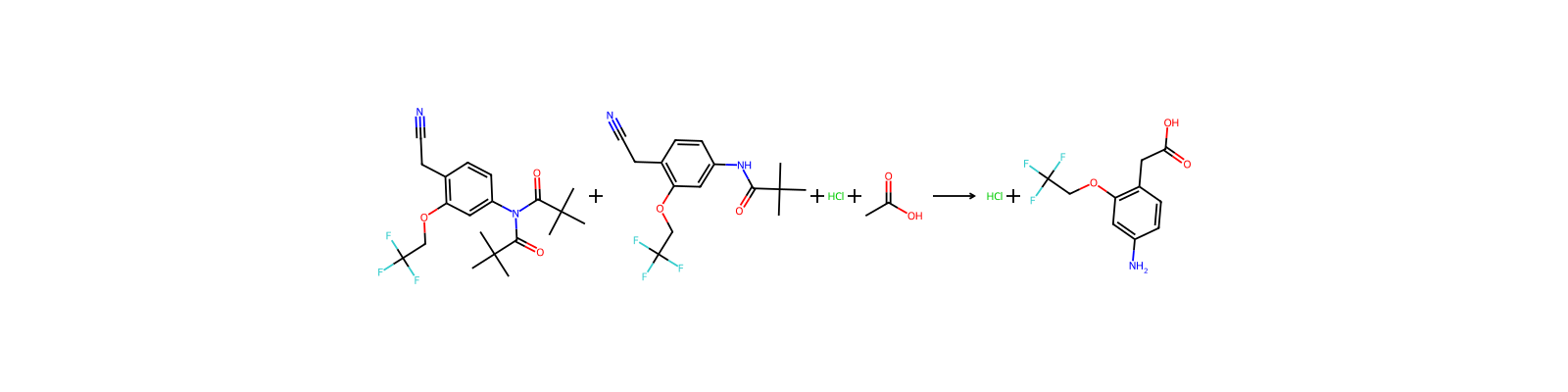
C(C([N:7]([C:14]1[CH:19]=[CH:18][C:17](CC#N)=[C:16]([O:23][CH2:24][C:25]([F:28])([F:27])[F:26])[CH:15]=1)C(C(C)(C)C)=O)=O)(C)(C)C.C(C(NC1C=CC(CC#N)=C(OCC(F)(F)F)C=1)=O)(C)(C)C.[ClH:51].[C:52]([OH:55])(=[O:54])[CH3:53]>>[ClH:51].[NH2:7][C:14]1[CH:19]=[CH:18][C:17]([CH2:53][C:52]([OH:55])=[O:54])=[C:16]([O:23][CH2:24][C:25]([F:26])([F:27])[F:28])[CH:15]=1Participants
5




Procedure
A ~3:1 mixture of 4-(N,N-di-(tert-butylcarbonyl)-amino)-2-(2,2,2-trifluoroethoxy)phenylacetonitrile and 4-(tert-butylcarbonylamino)-2-(2,2,2-trifluoroethoxy)phenylacetonitrile (1.1 g) from Step 5 above was refluxed in a 1:1 mixture of acetic acid and concentrated aqueous HCl for 3 h. The solvents were removed under reduced pressure. The residue was dissolved in water and the solvent was evaporated under reduced pressure to remove residual acetic acid. 4-Amino-2-(2,2,2-trifluoroethoxy)phenylacetic acid hydrochloride was obtained as a colorless gum (HPLC retention time=4.2 min (method A)).
Workup
- customThe solvents were removed under reduced pressure
- dissolutionThe residue was dissolved in water
- customthe solvent was evaporated under reduced pressure
- customto remove residual acetic acid
Sources & evidence
- ORD record
- ord-17f4d90c901947ddb9ea57c617f67eda
- Source dataset
- uspto-grants-1999_10
- Patent number
- US05968938
Reaction notes
Loading…