Ethanol → HCID 53945782, compound
Reaction equation

[C:1]1([CH:7]2[CH2:12][CH2:11][NH:10][CH2:9][CH2:8]2)[CH:6]=[CH:5][CH:4]=[CH:3][CH:2]=1.[C:13]([N:21]1[CH2:26][CH2:25][CH:24](N2CCC(C3C=CC=CC=3)CC2)[CH:23](O)[CH2:22]1)(=[O:20])[C:14]1[CH:19]=[CH:18][CH:17]=[CH:16][CH:15]=1.CC[OH:42]>>[C:13]([N:21]1[CH2:26][CH2:25][CH:24]([OH:42])[CH:23]([N:10]2[CH2:9][CH2:8][CH:7]([C:1]3[CH:6]=[CH:5][CH:4]=[CH:3][CH:2]=3)[CH2:12][CH2:11]2)[CH2:22]1)(=[O:20])[C:14]1[CH:19]=[CH:18][CH:17]=[CH:16][CH:15]=1Participants

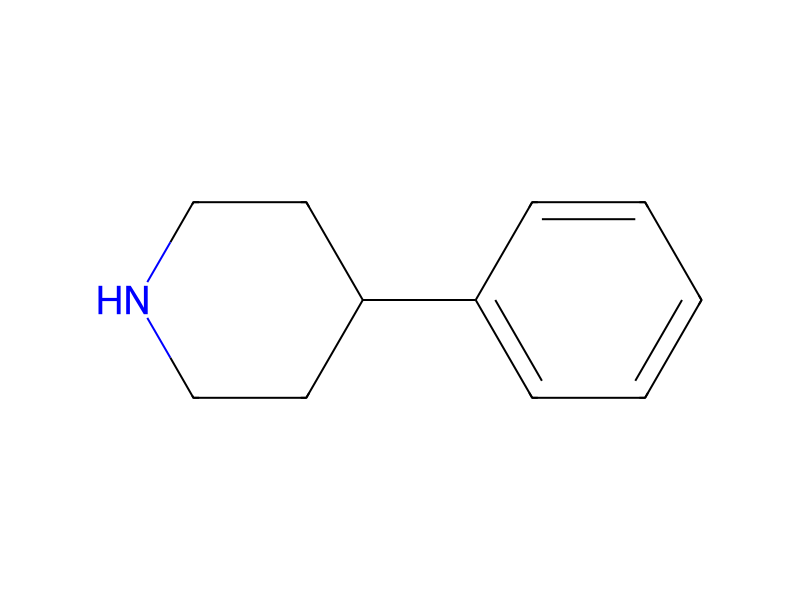


Procedure
Benzoyl chloride (6.22, 44.3 mmol) was added dropwise to a cold (icebath) stirring solution containing 3.2 g (38.5 mmol) of 1,2,3,6-tetrahydropyridine in Et3N (30 ml). Following the addition, the mixture was allowed to slowly warm up to room temperature. After 24 hours, the reaction mixture was diluted with H2O (30 ml) and extracted with CH2Cl2 (85 ml). The organic extract was washed with saturated NaHCO3 (50 ml), dried over anhydrous Na2SO4 and concentrated in vacuo to yield a chromatographically homogeneous yellow liquid (quant); 1H NMR (CDCl3) δ2.20 (d,2H), 3.46 (br s, 2H), 3.86 (br s, 2H), 4.20 (br s, 1H), 5.86 (m, 1H), 7.40 (s, 5H). The latter was redissolved in CH2Cl2 (140 ml) and cooled in an icebath. To this cold stirring solution m-CPBA (14.40 g; 50-60% pure) was added portionwise over 10 min. After completion of the addition, the reaction mixture was maintained a 4° C. for 1 hour and allowed to slowly warm up to room temperature. Sixteen hours later, the reaction mixture was diluted with CCl4 (100 ml) and filtered to remove precipitated 3-chlorobenzoic acid. The filtrate was washed consecutively with 5% aq. NaHSO3 (2×100 ml) and satd NaHCO3 (2×100 ml), dried over anhydrous Na2SO4 and concentrated in vacuo to provide 6.93 g of the crude epoxide as a brown syrup. A solution of the epoxide and 5.64 g (35.0 mmol) of 4-phenylpiperidine in EtOH (100 ml) was refluxed for 15 hours, cooled and concentrated to a brown residue. The latter was dissolved in CH2Cl2 (150 ml) and the resulting solution was washed with H2O (70 ml), dried over anhydrous Na2SO4 and concentrated to a syrup which was purified by preparative HPLC (silica gel; i-PrOH 910): hexanes (90): Et3N(1) to yield two major components. The more mobile component identified as 9a was obtained in 25% yield: The corresponding hydrochloride was recrystallized from i-PrOH-MeOH mp 220°-223° C.; 1H NMR (CDCL3) δ1.61-1.89 (m, 6 H), 2.29 (t, 1H), 1.46-1.53 (m, 2H), 2.81 (m, 4H), 2.96 (m, 1H), 3.45 (m, 1H), 3.83 (m, 1H), 4.69 (m, 1H), 4.88 (m, 1H), 7.19-7.40 (m, 10H). The less mobile component was assigned the structure 10a: mp (HCl) 248°-251° C.; 1H NMR (CDCl3) δ1.50-3.07 (m, 12H), 3.67-3.79 (m, 4H), 4.78 (m, 1H), 4.92 (m, 1H), 7.20-7.44 (m, 10H). The less mobile component was assigned the structure 10a: mp (HCl) 248°-251° C.; 1H NMR.
Workup
- temperaturecooled
- concentrationconcentrated to a brown residue
- dissolutionThe latter was dissolved in CH2Cl2 (150 ml)
- washthe resulting solution was washed with H2O (70 ml)
- dry with materialdried over anhydrous Na2SO4
- concentrationconcentrated to a syrup which
- customwas purified by preparative HPLC (silica gel; i-PrOH 910)
- customhexanes (90): Et3N(1) to yield two major components
- customwas obtained in 25% yield
- customThe corresponding hydrochloride was recrystallized from i-PrOH-MeOH mp 220°-223° C.
- custommp (HCl) 248°-251° C.
- custommp (HCl) 248°-251° C.
Sources & evidence
- ORD record
- ord-9edfce7d664944e58aae2dc6fd00e2ff
- Source dataset
- uspto-grants-1994_08
- Patent number
- US05338852
Reaction notes
Loading…