
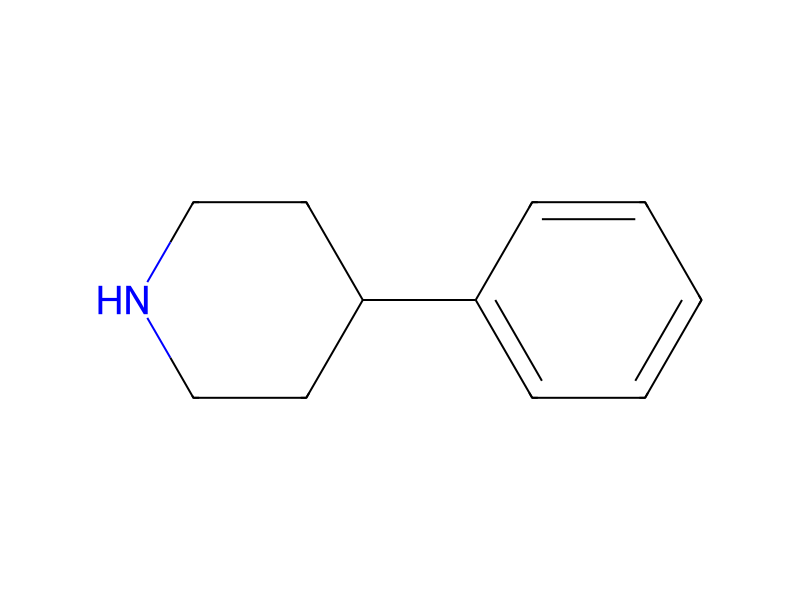
Basic information
- Standard SMILES
c1ccc(C2CCNCC2)cc1- InChIKey
UTBULQCHEUWJNV-UHFFFAOYSA-N- Molecular formula
- C11H15N
- Average molar mass
- 161.24 g/mol
- Monoisotopic mass
- 161.12044948
Names & identifiers
- Preferred name
- 4-Phenylpiperidine
- IUPAC
- 4-phenylpiperidine
- English name
- 4-Phenylpiperidine
- Molecular formula
- C11H15N
- Molecular weight
- 161.24
Names & synonyms
4-Phenylpiperidine771-99-38V8IM567WTDTXSID40227890NSC-89743RefChem:100377DTXCID90150381212-243-14-Phenyl-piperidinePiperidine, 4-phenyl-MFCD000060024-Phenyl piperidine
Show more names
NSC 897434-PHENYLPIPERDINEAKOS BBS-00003581TIMTEC-BB SBB003943RARECHEM AH CK 01604-Phenyl piperadine4-Phenylpiperidine>4-PHENYLPIPERIDINE,99%
4-(phenyl)piperidine(4-phenyl)piperidineEINECS 212-243-1SCHEMBL4574CHEMBL20969CS-D0605AKOS000208931AB00564
Database identifiers
- CAS
771-99-3- PubChem CID
- 69873
- DTXSID
DTXSID40227890- ChEMBL
CHEMBL20969- UNII
- 8V8IM567WT
- EC Number
- 212-243-1
- Nikkaji
- J99J
Properties
Computed structural properties
- XLogP
- 2
- Topological polar surface area
- 12 Ų
- Hydrogen bond donors
- 1
- Hydrogen bond acceptors
- 1
- Rotatable bonds
- 1
- Heavy atoms
- 12
- Formal charge
- 0
- Complexity
- 121
Experimental & physicochemical properties
Kovats Retention Index1454
Physicochemical properties
- Melting point
- 61 · 61-65 °C (lit.)
- Boiling point
- 286 °C · 286 °C(lit.)
- Density
- 1.062 g/mL · 1.062 g/mL at 25 °C(lit.)
- refractive index
- 20 · n20/D 1.588(lit.)
- Flash point
- 230 °F · >230 °F
- storage temp.
- Keep in dark place,Inert atmosphere,Room temperature
- form
- Powder
- pka
- 10.2 · 10.20±0.10(Predicted)
- color
- Yellow to brown
- Water Solubility
- Soluble in water.
- BRN
- 124508 · 124508
- InChI
- InChI=1S/C11H15N/c1-2-4-10(5-3-1)11-6-8-12-9-7-11/h1-5,11-12H,6-9H2
- InChIKey
- UTBULQCHEUWJNV-UHFFFAOYSA-N
- SMILES
- N1CCC(C2=CC=CC=C2)CC1
- CAS DataBase Reference
- 771 · 771-99-3(CAS DataBase Reference)
- FDA UNII
- 8 V8IM567WT · 8V8IM567WT
- NIST Chemistry Reference
- 4 · 4-Phenylpiperidine(771-99-3)
- UNSPSC Code
- 12352100 · 12352100
- NACRES
- 22 · NA.22
- Symbol(GHS)
- 7 · GHS07
- Signal word
- Warning
- Hazard statements
- 315 · H315-H319-H335
- Precautionary statements
- 261 · P261-P264-P271-P280-P302+P352-P305+P351+P338
- Hazard Codes
- T,Xi,C,F
- Risk Statements
- 36 · 36/37/38-34-11-20/21/22
- Safety Statements
- 26 · 26-36/37/39-45-37/39-36/37-16
- RIDADR
- 2922 · UN 2922 8/PG 2
- WGK Germany
- 3 · 3
- RTECS
- 2625000 · TM2625000
- F
- 10 · 10
- HazardClass
- IRRITANT
- HS Code
- 29333990 · 29333990
Safety & regulation
GHS classification
GHS Classification
Warning
H315 (98%): Causes skin irritation [Warning Skin corrosion/irritation];H319 (98%): Causes serious eye irritation [Warning Serious eye damage/eye irritation];H335 (96%): May cause respiratory irritation [Warning Specific target organ toxicity, single exposure; Respiratory tract irritation]
P261, P264, P264+P265, P271, P280, P302+P352, P304+P340, P305+P351+P338, P319, P321, P332+P317, P337+P317, P362+P364, P403+P233, P405, and P501 (click each P-code to see the statement)
Aggregated GHS information provided per 50 reports by companies from 7 notifications to the ECHA C&L Inventory. Each notification may be associated with multiple companies.;Information may vary between notifications depending on impurities, additives, and other factors. The percentage value in parenthesis indicates the notified classification ratio from companies that provide hazard codes. Only hazard codes with percentage values above 10% are shown. For more detailed information, please visit ECHA C&L website.
Hazard information
Hazard Classes and CategoriesSkin Irrit. 2 (98%);Eye Irrit. 2 (98%);STOT SE 3 (96%)
Safety data
- F
- 10
- wgk
- 3
- rtecs
- TM2625000
- ridadr
- UN 2922 8/PG 2
- hs_code
- 29333990
- risk_code
- 36/37/38-34-11-20/21/22
- Signal word
- Warning
- Symbol(GHS)
- GHS07
- hazard_code
- T,Xi,C,F
- safety_code
- 26-36/37/39-45-37/39-36/37-16
- hazard_class
- IRRITANT
- Hazard statements
- H315-H319-H335
- Precautionary statements
- P261-P264-P271-P280-P302+P352-P305+P351+P338
Chemistry & industry
Applications
Uses4-Phenylpiperidine is an important raw material and intermediate used in organic synthesis, pharmaceuticals, agrochemicals and dyestuff.
Upstream & downstream products
Upstream raw materials
Downstream products
Suppliers50 total
梯希爱(上海)化成工业发展有限公司021-67121386 · [email protected]
衢州润东化工有限公司0570-8789886 18892685668 · [email protected]
上海阿拉丁生化科技股份有限公司400-6206333 13167063860 · [email protected]
上海泰矶林实业有限公司02150630626 17717886015 · [email protected]
河北展药生物科技有限公司15369953316 +8615369953316 · [email protected]
Baoji Guokang Healthchem co.,ltd+8615604608665 15604608665 · [email protected]
Dayang Chem (Hangzhou) Co.,Ltd.+86-0571-88938639 17705817739 · [email protected]
科瑞迪化学400-821-5857 021-64326257 · [email protected]
韶远科技(上海)有限公司021-50795510 4000665055 · [email protected]
Ark Pharm, Inc.847-367-3680 · [email protected]
上海迈瑞尔生化科技有限公司4006356688 18621169109 · [email protected]
上海德默医药科技有限公司400-021-7337 2355568890 · [email protected]
安耐吉化学&3A(安徽泽升科技股份有限公司)400-0056266 · [email protected]
武汉凯威斯科技有限公司86-027-67849912 · [email protected]
上海恩诺生物科技有限公司+86 (21) 6435-5022
上海瀚鸿科技股份有限公司021-54306202 13764082696 · [email protected]
上海景颜化工科技有限公司13817811078 · [email protected]
Pure Chemistry Scientific Inc.001-857-928-2050 or 1-888-588-9418 · [email protected]
Zhejiang J&C Biological Technology Co.,Limited+1-2135480471 · [email protected]
成都福尔斯特医药技术有限公司028-87078428 028-87074958 · [email protected]
杰达维(上海)医药科技发展有限公司/J & W PharmLab021-64340559 · [email protected]
Abblis Chemicals LLC+1-832-373-8299 · [email protected]
四川库利南科技有限公司400-1166-196 18981987031 · [email protected]
天津希恩思生化科技有限公司400 638 7771 · [email protected]
南京维奥化工有限公司Please Send Email 18652950785 · [email protected]
赛默飞世尔科技(中国)有限公司800-810-5118 · [email protected]
上海特伯化学科技有限公司+86-21-60341587 · [email protected]
南京诺利斯医药科技有限公司13901585132 · [email protected]
TCI AMERICA800-4238616 · [email protected]
TOKYO CHEMICAL INDUSTRY CO., LTD.03-36680489 · [email protected]
Labex Corporation+91-11-26135922 or +91-11-46160359 · [email protected]
上海睿升化工科技有限公司+86-021-50935922
上海灏云化工科技有限公司021-68367562 · [email protected]
上海将来实业股份有限公司021-61552785 · [email protected]
安徽科迪达化工有限公司0554-2106669 · [email protected]
HBCChem, Inc.+1-510-219-6317 · [email protected]
Labnetwork lnc.+86-27-50766799 +86-18062016861 · [email protected]
重庆星灿医药科技有限公司13594048950 19923294409 · [email protected]
雷丁试剂0510-85629785 18013409632 · [email protected]
上海卓因生物科技有限公司021-61317773 · [email protected]
湖南华腾制药有限公司400-8592883 · [email protected]
上海马氏化学科技有限公司19916721580 · [email protected]
上海嵩爰化工科技有限公司010-1234567 18521000990 · [email protected]
江苏艾康生物医药研发有限公司025-66028182 17714375163 · [email protected]
上海拓目化工有限公司13391076197 · [email protected]
Sigma-Aldrich西格玛奥德里奇(上海)贸易有限公司021-61415566 800-8193336 · [email protected]
Accela ChemBio Inc.+1(858) 699-3322 · [email protected]
成都赛诺宁科技有限公司28-87999436 02887999436 · [email protected]
上海威芬奇医药科技有限公司13817485796 · [email protected]
成都瑞欧克科技有限公司028-64353063 · [email protected]
Additional notes
Definition4-Phenylpiperidine is a benzene ring bound to a piperidine ring. It is the base structure for a variety of opioids, such as pethidine (meperidine), ketobemidone, alvimopan, loperamide, and diphenoxylate.
Related reactions
17,507 records


Linked notes
Loading…