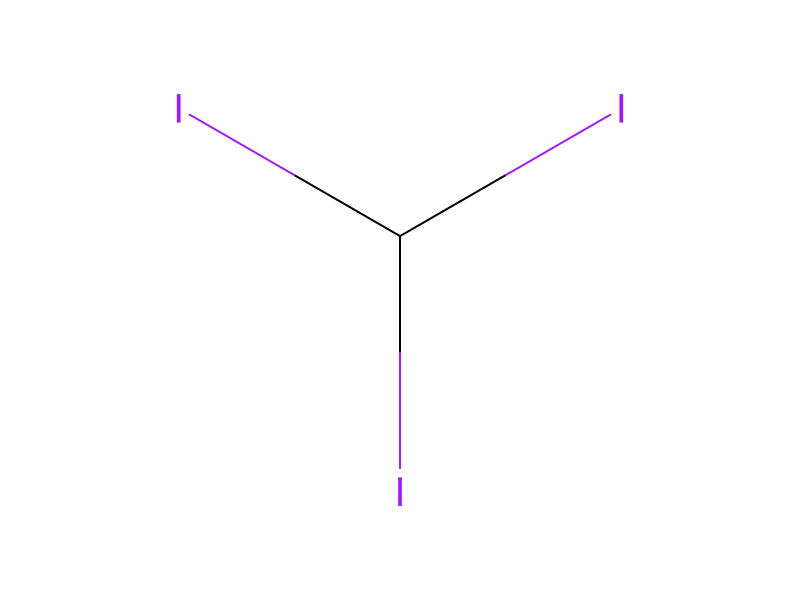
Iodoform → HCID 131733548, compound
Reaction equation

C1(P(C2C=CC=CC=2)C2C=CC=CC=2)C=CC=CC=1.[CH:20]([I:23])(I)I.CC(C)([O-])C.[K+].[CH3:30][C:31]1([CH3:61])[O:35][C@@H:34]2[CH:36]([CH2:40][O:41][C:42]([C:55]3[CH:60]=[CH:59][CH:58]=[CH:57][CH:56]=3)([C:49]3[CH:54]=[CH:53][CH:52]=[CH:51][CH:50]=3)[C:43]3[CH:48]=[CH:47][CH:46]=[CH:45][CH:44]=3)[O:37][CH:38](O)[C@@H:33]2[O:32]1>C(=O)=O.CC(C)=O.C1(C)C=CC=CC=1>[I:23][CH:20]=[C:38]1[C@H:33]2[C@H:34]([O:35][C:31]([CH3:30])([CH3:61])[O:32]2)[CH:36]([CH2:40][O:41][C:42]([C:55]2[CH:60]=[CH:59][CH:58]=[CH:57][CH:56]=2)([C:43]2[CH:44]=[CH:45][CH:46]=[CH:47][CH:48]=2)[C:49]2[CH:54]=[CH:53][CH:52]=[CH:51][CH:50]=2)[O:37]1Participants





Procedure
Into a 20 L reactor was charged triphenylphosphine (2.55 kg, 9.72 mol, 2.1 eq) and iodoform (3.83 kg, 9.72 mol, 2.1 eq), followed by toluene (8 L). The stirred solution was cooled down to −20° C. in dry ice/acetone bath. Potassium tert-butoxide (1.13 kg, 9.26 mol, 2 eq) was added in portions (within ˜30 minutes) while keeping reaction temperature<10° C. The mixture turned dark and some precipitates formed. After addition, the suspension was stirred another hour at 5˜10° C. A solution of compound 2 (2 kg, 4.63 mol, 1 eq) in toluene (5 L) was added to the suspension at 5° C. The reaction was quenched with brine (1.5 L) after 1.5 hours. HPLC showed the ratio of 2 (6.4 min) and 3 (˜9.8 min) as about 1:3, while little or no by-product 3a (where the OH group of 3 is added with elimination of HI onto the double bond of 2 to form (3aR,6aR)-4-(iodomethylene)-2,2-dimethyl-6-((trityloxy)methyl)tetrahydrofuro[3,4-d][1,3]dioxole) was observed. The reaction mixture was diluted with ethyl acetate (2 L) and stirred 15 minutes to get a diluted suspension. Eight such 20 L reactions were combined. The supernatant was decanted and centrifuged. The residue was diluted with water (40 L) and ethyl acetate (40 L). The suspension was stirred for 10 minutes and then centrifuged. The solid was washed with 40 L of ethyl acetate once. The filtrate and wash were combined. Layers were cut. The organic layer was washed with brine (30 L) and water (30 L). It was then concentrated to dryness (temperature of the water bath<50° C.). The residue was loaded on a silica column and eluted first with petroleum ether/ethyl acetate (10:1), and then with petroleum ether/ethyl acetate/dichloromethane (20:1:1). After the desired product appeared, the column was washed with petroleum ether/ethyl acetate/dichloromethane (5:1:1). Altogether 5.3 kg of 3 was obtained (HPLC purity 95%, yield 21%). A sample from the reaction mixture and standard samples for compounds 2 and 3 were applied to a commercial silica gel TLC plate, and the plate was run in petroleum ether/ethyl acetate=4:1. Compounds 2, 3 and 3a can be detected under UV254. They can also be visualized with iodine. The Rf for compound 2 was ˜0.4. The Rf for 3 was ˜0.7. The Rf for 3a was ˜0.9.; 1H-NMR (300 MHz, CDCl3), δ 7.23-7.46 (m, 15H), 7.05 (d, J=8.4 Hz, 1H), 4.53 (dd, J=5.7, 8.4 Hz, 1H), 4.19 (dd, J=5.7, 8.4 Hz, 1H), 3.67 (m, 1H), 3.32 (d, J=4.8 Hz, 1H), 2.46 (d, J=4.8 Hz, 1H), 1.34 (s, 3H), 1.33 (s, 3H); 13C-NMR (75 MHz, CDCl3) δ147.65 (—CH═CI2), 143.75, 128.68, 128.00, 127.29, 127.23, 109.55, 86.97, 83.39, 77.21, 69.19, 27.84, 25.52, 15.99 (═CI2).
Workup
- customreaction temperature<10° C
- customsome precipitates formed
- additionAfter addition
- customThe reaction was quenched with brine (1.5 L) after 1.5 hours
- customthe ratio of 2 (6.4 min) and 3 (˜9.8 min)
- additionwhile little or no by-product 3a (where the OH group of 3 is added with elimination of HI onto the double bond of 2
Sources & evidence
- ORD record
- ord-9e076294392b4925babc9a051bf78104
- Source dataset
- uspto-grants-2015_10
- Patent number
- US09150520B2
Reaction notes
Loading…