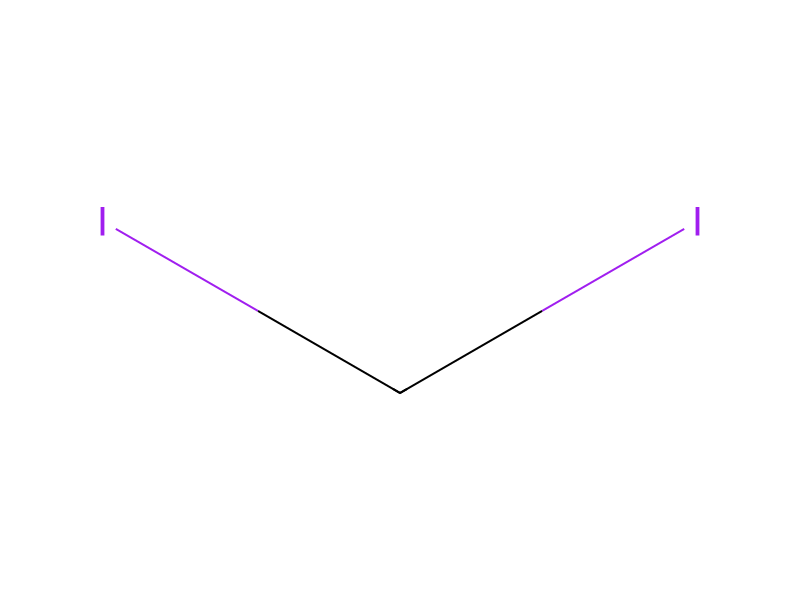
Diiodomethane → Methyl 3-cyclopropylpyridine-2-carboxylate
Reaction equation

ICI.C([Zn]CC)C.[CH3:9][CH2:10][CH2:11][CH2:12][CH2:13][CH3:14].C(C1[C:18]([C:23]([O:25][CH3:26])=[O:24])=[N:19][CH:20]=CC=1)=C>C(Cl)Cl.[Cl-].[NH4+]>[CH:11]1([C:12]2[C:18]([C:23]([O:25][CH3:26])=[O:24])=[N:19][CH:20]=[CH:14][CH:13]=2)[CH2:9][CH2:10]1Participants





Procedure
To a stirred solution of diiodomethane (2.46 g, 9.20 mmol) in dry DCM (5 ml) at −10° C. was added diethyl zinc in hexane (1 M, 9.2 ml, 9.20 mmol). The reaction was stirred for 30 minutes under nitrogen. To this was then added methyl 3-ethenylpyridine-2-carboxylate (0.30 g, 1.84 mmol) as a solution in DCM (5 ml) over a 15 minute period. The reaction was then allowed to warm to room temperature and was stirred at room temperature for 15 hours. The reaction mixture was diluted with a saturated solution of ammonium chloride (25 ml) and the organics were extracted with ethyl acetate (3×30 ml). The combined organics were washed with water (25 ml), brine (25 ml), dried over sodium sulfate and concentrated in vacuo. The resulting residue was purified by column chromatography (silica, 0-15% ethyl acetate/n-hexane to afford the title compound.
Workup
- stirringwas stirred at room temperature for 15 hours
- extractionthe organics were extracted with ethyl acetate (3×30 ml)
- washThe combined organics were washed with water (25 ml), brine (25 ml)
- dry with materialdried over sodium sulfate
- concentrationconcentrated in vacuo
- customThe resulting residue was purified by column chromatography (silica, 0-15% ethyl acetate/n-hexane
Sources & evidence
- ORD record
- ord-492dac1536614cd9a0dc88df3298a9b0
- Source dataset
- uspto-grants-2015_10
- Patent number
- US09156829B2
Reaction notes
Loading…