Dimethyl Sulfate → Methyl 5-bromo-4-fluoro-2-methoxy-3-nitrobenzoate
Reaction equation
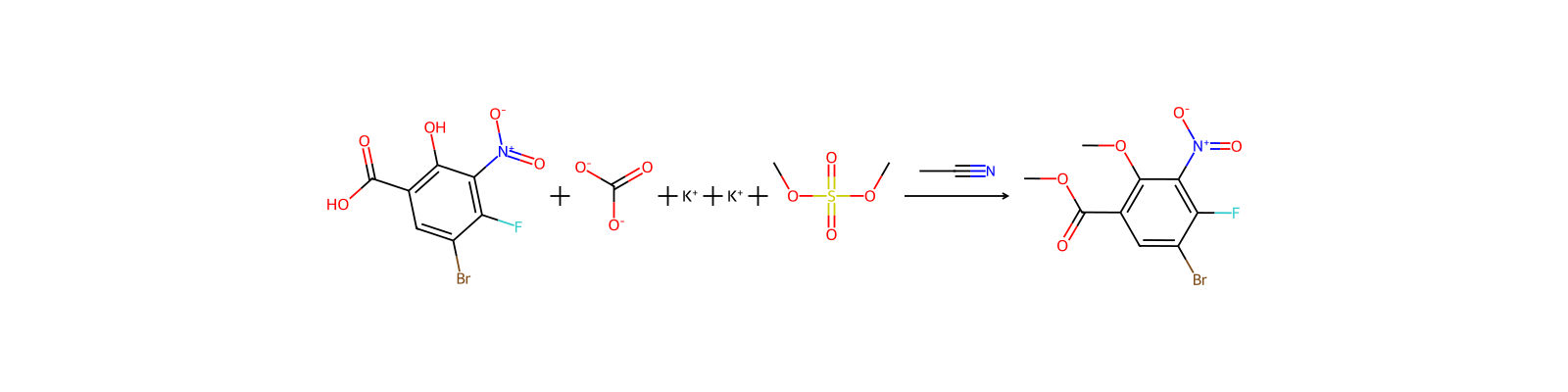
[Br:1][C:2]1[C:3]([F:15])=[C:4]([N+:12]([O-:14])=[O:13])[C:5](O)=[C:6]([CH:10]=1)[C:7]([OH:9])=[O:8].[C:16](=O)([O-])[O-].[K+].[K+].S([O:27][CH3:28])(OC)(=O)=O>C(#N)C>[Br:1][C:2]1[C:3]([F:15])=[C:4]([N+:12]([O-:14])=[O:13])[C:5]([O:27][CH3:28])=[C:6]([CH:10]=1)[C:7]([O:9][CH3:16])=[O:8]Participants
5





Procedure
5-Bromo-4-fluoro-2-hydroxy-3-nitrobenzoic acid (I-228) (35.89 g, 0.128 mol) was dissolved in acetonitrile (600 ml), then at room temperature, potassium carbonate (53.1 g, 0.358 mol) was added, and dimethyl sulfate (30.3 ml, 0.32 mol was dropwise added. After staring at 60° C. for 2.5 hour and then cooling to room temperature, the insoluble matter was removed by filtration (with washing with acetonitrile (400 ml)). The filtrate was concentrated under reduced pressure (about 800 ml of acetonitrile was evaporated away), and water (800 ml) was added to the residue, followed by stirring at room temperature. The precipitated crystal was washed with water and dried to obtain the entitled compound (36.5 g, 92%) as a pale yellow solid.
Workup
- customthe insoluble matter was removed by filtration (with washing with acetonitrile (400 ml))
- concentrationThe filtrate was concentrated under reduced pressure (about 800 ml of acetonitrile
- customwas evaporated away), and water (800 ml)
- additionwas added to the residue
- washThe precipitated crystal was washed with water
- customdried
Sources & evidence
- ORD record
- ord-817f578aa2bd495588519a1bd2cabb1e
- Source dataset
- uspto-grants-2010_06
- Patent number
- US07737166B2
Reaction notes
Loading…