Diisopropylethylamine → 2-Chloro-6-(3-(hydroxymethyl)morpholino)pyrimidine-4-carboxamide
Reaction equation
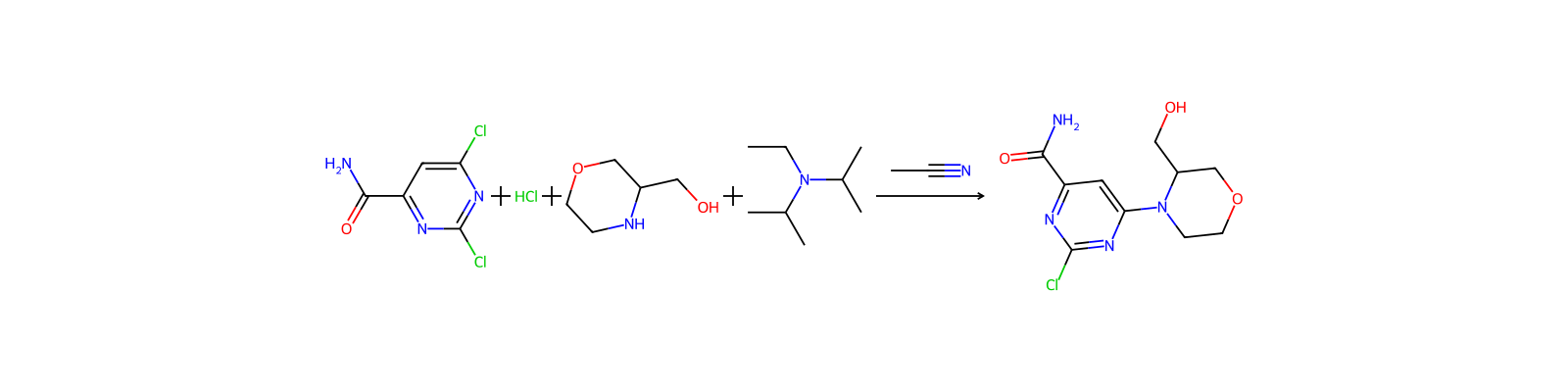
[Cl:1][C:2]1[N:7]=[C:6]([C:8]([NH2:10])=[O:9])[CH:5]=[C:4](Cl)[N:3]=1.Cl.[NH:13]1[CH2:18][CH2:17][O:16][CH2:15][CH:14]1[CH2:19][OH:20].CCN(C(C)C)C(C)C>C(#N)C>[Cl:1][C:2]1[N:7]=[C:6]([C:8]([NH2:10])=[O:9])[CH:5]=[C:4]([N:13]2[CH2:18][CH2:17][O:16][CH2:15][CH:14]2[CH2:19][OH:20])[N:3]=1Participants
5




Conditions
- Temperature
- 50 °C
Procedure
To a mixture of 2,6-dichloropyrimidine-4-carboxamide (0.384 g, 2.00 mmol) in acetonitrile (10 mL) was added morpholin-3-ylmethanol hydrochloride (0.310 g, 2.02 mmol) and iPr2NEt (0.77 mL, 4.4 mmol). The mixture was heated at 50° C. overnight then concentrated in vacuo. The residue was chromatographed over silica gel with 25-75% acetone in hexanes. The product fractions were evaporated in vacuo to yield 2-chloro-6-(3-(hydroxymethyl)morpholino)pyrimidine-4-carboxamide as a pale tan solid (0.501 g, 1.84 mmol, 92% yield). LC/MS: m/z=273.2 [M+H]+.
Workup
- concentrationthen concentrated in vacuo
- customThe residue was chromatographed over silica gel with 25-75% acetone in hexanes
- customThe product fractions were evaporated in vacuo
Sources & evidence
- ORD record
- ord-a8f5b7d6352d42838f9466bb485f0966
- Source dataset
- uspto-grants-2015_10
- Patent number
- US09163008B2
Reaction notes
Loading…