Hexane → Icosapent
Reaction equation

[C:1]([OH:20])(=[O:19])[CH2:2][CH2:3][CH2:4][CH2:5][CH2:6][CH2:7][CH2:8]/[CH:9]=[CH:10]\[CH2:11][CH2:12][CH2:13][CH2:14][CH2:15][CH2:16][CH2:17][CH3:18].[C:21](O)(=O)[CH2:22]CCCCCC/C=C\C/C=C\CCCCC.CCCCCC>C(OCC)(=O)C.CCCCCCC>[CH3:21][CH2:22]/[CH:18]=[CH:17]\[CH2:16]/[CH:15]=[CH:14]\[CH2:13]/[CH:12]=[CH:11]\[CH2:10]/[CH:9]=[CH:8]\[CH2:7]/[CH:6]=[CH:5]\[CH2:4][CH2:3][CH2:2][C:1]([OH:20])=[O:19]Participants
Reactant 3


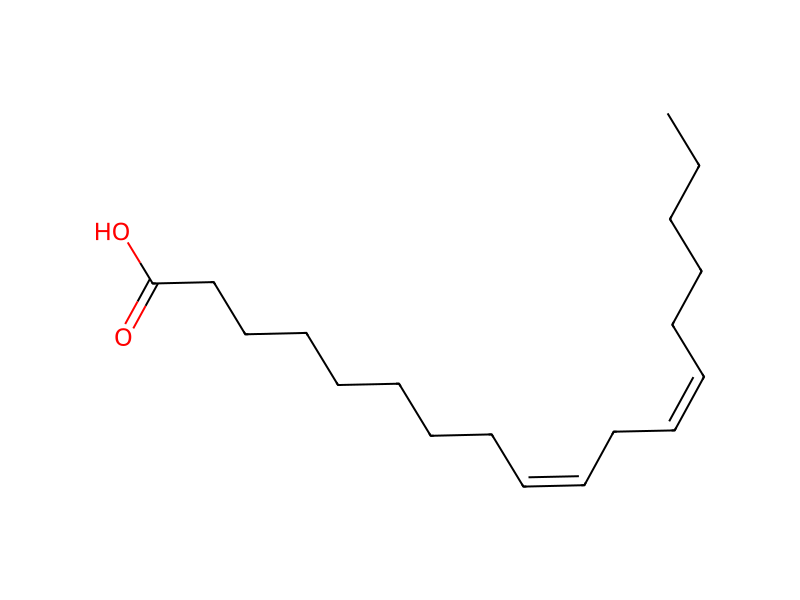
Product 1

Reagents, catalysts & solvents 2


Procedure
According to one embodiment of the invention and with reference to FIG. 2, a crude fish oil stream in line 100 is passed to a solvent mixing zone 200, wherein the crude fish oil stream in line 100 is admixed with a non-polar solvent stream in line 50 to provide a fish oil/solvent mixture. The crude fish oil stream comprises fatty acids of omega-3 fatty acids of eicosapentaenoic acid (EPA) or docosahexaenoic acid (DHA) along with other unsaturated triglyceride species including at least one of docosapentanoic acid (DPA), stearadonic acid (SDA), alpha linolenic acid (ALA), gamma linolenic acid (GLA), linoleic acid (LIN) and oleic acid (OLE) and free fatty acids, and depending upon the source also may contain saturated triglycerides including stearic acid (STA) and palmitic acid (PAL). Preferably, the non-polar solvent is selected from the group consisting paraffinic hydrocarbons such as hexane and heptane. More preferably, the non-polar solvent is heptane. Preferably, the fish oil/solvent mixture comprises a ratio of non-polar solvent to fish oil of from about 2 to about 3 times the volume of the fish oil. More preferably, the fish oil/solvent mixture comprises a ratio of non-polar solvent to fish oil of from about 2.3 to about 2.7 times the volume of the fish oil. Most preferably, the fish oil/solvent mixture comprises a ratio of non-polar solvent to fish oil of from about 2.5 times the volume of the fish oil. When the crude fish oil/solvent mixture is subjected an esterification reaction in the presence of a base and ethanol is introduced, the triglycerides are converted to esters and any free fatty acids are converted to Fatty Acid Ethyl Esters FAEE by acid catalyzed esterification process. Typically, the crude fish oil contains from about 1 to about 5 wt-% Free Fatty Acids FFA. If these FFA's are permitted to remain in the fish oil/solvent mixture in the transesterification step, they will be converted to soaps. To avoid the formation of soaps, the FFA's are first converted to ethyl esters in a pre-transesterification step, or esterification step in an esterification zone 210. In the esterification zone 210, the fish oil/solvent mixture is admixed with a polar solvent such as ethanol or ethanol in water in line 52 to form an esterification reaction mixture and the esterification reaction mixture is contacted with an acid catalyst stream comprising a mineral acid in line 51. Preferably, the acid catalyst stream comprises a 0.1 Normal sulfuric acid solution. The acid catalyst stream in line 51 is admixed with the esterification reaction mixture with an effective amount of the acid catalyst stream to the convert essentially all of the free fatty acids with ethanol to form fatty acid ethyl esters, wherein the effective amount of acid catalyst is at least about 5 wt-% of the weight of the crude fish oil in the esterification reaction mixture. The esterification reaction takes place at effective esterification conditions including an esterification reaction temperature at or below room temperature of 25° C. At the conclusion of the esterification reaction, water is introduced and the non-polar and polar phases are allowed to form. Non-polar esterification reaction effluent comprising solvent, fish oil and ethyl esters are withdrawn in line 54, and a polar esterification effluent comprising ethanol, water and sulfuric acid is withdrawn in line 53. The non-polar esterification reaction effluent in line 54 is passed to a transesterification zone 211, and therein admixed with a polar solvent stream in line 56 to form a transesterification reaction mixture and the transesterification reaction mixture is contacted with an effective amount of a basic catalyst stream in line 55. The polar solvent stream is selected from the group consisting of methanol, ethanol and isopropanol. Preferably, the polar solvent comprises ethanol. The basic catalyst stream in line 55 comprises a base metal hydroxide such a sodium or potassium hydroxide and dissolved in ethanol. The effective amount of the base metal hydroxide in the transesterification reaction zone is about 2 wt-% of the weight of the crude fish oil. Thus, the transesterification reaction zone 211 is a two-phase reaction zone wherein the esterification reaction takes place at the non-polar/polar solvent interface. Because the ester form of the fatty acids in the fish oil are not soluble in the polar solvent phase, they are immediately removed from the reaction zone at the interface between the polar and non-polar phases and migrate to and become concentrated in the non-polar phase as the reaction proceeds. During the reaction, the transesterification reaction zone is maintained at effective transesterification reaction conditions including a reaction temperature at or below room temperature (25° C.) and the reaction mixture is continuously stirred. By maintaining the transesterification temperature at or below a room temperature of 25° C., any side reactions which could potentially destroy valuable EPA or DHA are minimized. Glycerol is produced as a byproduct of the transesterification reaction. The removal of the ester form into the non-polar phase further serves to improve conversion by separating the ester phase from any water formed in the reaction which if contacted with the ester could reverse the reaction. The two-phase transesterification reaction effluent stream in line 58 is withdrawn from the transesterification zone 211 and passed to a wash/separation zone 212a/212b. In the wash/separation zone 212a/212b, the two-phase transesterification reaction effluent stream in line 58 is washed with water introduced via line 59; and, after stabilization and subsequent phase separation provides an aqueous phase in line 60 comprising ethanol, water and glycerol, and a non-polar transesterification effluent stream in line 61. The non-polar transesterification effluent stream in line 61 comprises the non-polar solvent, triglycerides, water, alcohol such as methanol, and ethyl esters. The non-polar transesterification effluent stream in line 61 is passed directly to a finishing zone, or finishing column 220 containing an adsorbent such as silica to remove any remaining water and alcohol from the transesterification effluent stream in line 61 to provide a finished feed stream in line 62, which is essentially free of water and alcohol. By essentially free of water and alcohol, it is meant that the amount of water and alcohol in the finished stream is less than 100 ppm. The finished feed stream in line 62 is passed to a cascade of three SMB zones to obtain a high purity EPA product stream; however, this cascade differs from the cascade shown in FIG. 1 in that the first SMB zone 214 is a normal phase SMB using a hydrophilic stationary phase agent and using a first stage mobile phase desorbent comprising a non-polar solvent/organic polar solvent mixture in an effective ratio of non-polar solvent to organic polar solvent. It was surprisingly discovered that essentially all of the OLE and LIN major impurities can be removed from the extract of the first SMB zone of the present invention. The prior art scheme is not able to completely remove OLE and LIN. Any remaining traces of OLE and LIN remain in the final EPA product, thus reducing the purity of the final EPA product. The second SMB zone 203 and the third SMB zone 206 employ a reversed phase SMB mode using a hydrophobic stationary phase agent and a second and third stage mobile phase desorbent comprising a polar solvent. Referring again to FIG. 2, the finished feed stream in line 62 and a first SMB desorbent stream in line 63 are passed to the first SMB zone to provide a first SMB extract stream in line 64 and a first primary SMB raffinate stream in line 65. The first primary SMB raffinate stream in line 65 comprises the non-polar solvent, and non-Omega-3 ethyl esters such as OLE (Oleic), LIN (Linoleic), and optionally, palmetic. A first secondary SMB raffinate stream, not shown, is also produced and employed directly as first mobile phase desorbent recycle stream of which at least a portion is combined with the first mobile phase desorbent stream in line 63 to offset the overall requirement for the first mobile phase desorbent stream. The first mobile phase desorbent stream in line 63 comprises a mixture of from 95 to 99 parts n-heptane or hexane to 5-1 parts a polar organic compound, such as ethyl acetate. Most preferably, the first mobile phase desorbent stream comprises a ratio of 98:2 parts n-heptane to ethyl acetate. The first SMB zone 214 has a plurality of adsorbent beds (at least 8) containing a stationary phase adsorbent and arranged serially in a manner which is described hereinbelow in FIG. 3. The first stationary phase adsorbent is a silica adsorbent. The first SMB extract stream in line 64 comprises heptane, ethyl acetate, omega-3 fatty acid esters and other fatty acid esters of at least one of DPA, SDA, ALA, and GLA. The first SMB extract stream in line 64 is essentially free of any OLE or LIN; that is, that there was no detectable concentration of OLE or LIN in the first SMB extract stream. More particularly, by essentially free of OLE or LIN, there is less than 0.1 wt-% of either LIN or OLE in the first SMB extract stream. If DPA or DHA were present in the finished feed stream in line 62, then DPA and DHA also would be present in the first SMB extract stream in line 64. The first SMB raffinate stream in line 65 comprises fatty acid esters of OLE, LIN, and the polar and non-polar solvents such as heptane and ethyl acetate. The extract concentration of EPA in the first SMB extract stream in line 64 is enhanced relative to the feed concentration of EPA in the finished feed stream in line 62. The first extract stream in line 64 is passed to an first extract solvent recovery zone 216 to separate the esters from the solvents to provide a first solvent free extract stream, or an enhanced omega-3 ester product stream, in line 70 comprising the omega-3 fatty acid esters of EPA or DHA or mixtures thereof, and a first SMB1 recovered solvent stream in line 68, consisting of the non-polar solvent, heptane, and polar solvent, ethyl acetate. The first solvent free extract stream is essentially free of non-polar solvent having less than about 30 ppm non-polar solvent. Optionally, the first solvent free extract stream is passed to a further finishing zone (not shown) wherein the first solvent free extract stream is contacted with a silica adsorbent to substantially remove any remaining non-polar solvent from the first solvent free extract stream. The first primary raffinate stream in line 65 is passed to a first raffinate solvent recovery zone 218 to separate the ester phase comprising non-polar solvent and non-omega-3 components including fatty acid esters of LIN and OLE, from the non-polar solvent to provide a first SMB reject stream in line 66 and a second SMB1 recovered solvent stream in line 67, consisting of the non-polar solvent, heptane and ethyl acetate. The first reject stream in line 66 can be employed as a component of biodiesel or sent for further recovery of remaining fatty acid esters (Not shown). The solvent recovery zones 216 and 218 separate the solvent by evaporization or vacuum distillation. At least a portion of each of the first SMB1 recovered solvent stream in line 68 and the second SMB1 recovered solvent stream in line 67 are recycled to makeup a portion of the mobile phase desorbent stream in line 63 (not shown). The recovered solvent streams in lines 67 and 68 can be recycled to provide at least a portion of the non-polar solvent stream in line 50 (not shown). The first solvent free extract stream in line 70 and a second mobile phase desorbent stream in line 118 comprising a mixture of methanol and water are passed to a second SMB (simulated moving bed) zone 203. The second mobile phase desorbent stream has a ratio of methanol to water of about 93:7 on a volume basis. The second SMB zone 203 has a plurality of adsorbent beds (at least 8 adsorbent beds) containing a second stationary phase adsorbent and the adsorbent beds are arranged serially in a manner which is described hereinbelow in FIG. 3. The second stationary phase adsorbent is a hydrophobic C8 or C18 adsorbent. Preferably, the second stationary phase adsorbent is C18. A second SMB extract stream in line 120 is withdrawn from the second SMB zone 203 and passed to a second extract solvent recovery zone 204 to provide a second reject stream in line 126 and a first SMB2 recovered solvent stream in line 128. A second primary raffinate stream is withdrawn in line 122 and passed to a second raffinate solvent recovery zone 205 to provide a first evaporated raffinate stream in line 124 and a second SMB2 recovered solvent stream in line 130. At least a portion of each of the first SMB2 recovered solvent stream in line 128 and the second SMB2 recovered solvent stream in line 130 are recycled to makeup a portion of the second mobile phase desorbent stream in line 118 (not shown). The second reject stream in line 126 can be employed as a component of biodiesel or sent for further recovery of remaining fatty acid esters (not shown). The solvent recovery zones 204 and 205 separate the solvent by evaporization or vacuum distillation. The second evaporated raffinate stream as a third feed stream in line 124 and a third mobile phase desorbent stream in line 132 comprising a mixture of methanol and water are passed to a third SMB zone (SMB2) 206. The third mobile phase desorbent stream has a ratio of methanol to water of about 93:7 on a volume basis. The third SMB zone 206 has a plurality of adsorbent beds (at least 8 adsorbent beds) containing a third stationary phase adsorbent and arranged serially in a manner which is described hereinbelow in FIG. 3. The third stationary phase adsorbent is a hydrophobic C8 or C18 adsorbent. Preferably, the third stationary phase adsorbent is C18. A third SMB extract stream in line 134 is withdrawn from the third SMB zone and passed to an SMB3 extract solvent recovery zone 207 to provide a high purity EPA product stream in line 136 and a first SMB3 recovered solvent stream in line 140. A third primary raffinate stream is withdrawn from the third SMB zone 206 in line 142 and passed to an SMB3 raffinate solvent recovery zone 208 to provide a third evaporated raffinate stream in line 144 which represents a third reject stream, and a second SMB3 recovered solvent stream in line 146. At least a portion of each of the first SMB3 recovered solvent stream in line 140 and the second SMB3 recovered solvent stream in line 146 are recycled to makeup a portion of the desorbent stream in line 132. The third reject stream in line 144 can be employed as a component of biodiesel or sent for further recovery of remaining fatty acid esters (Not shown). The solvent recovery zones 207 and 208 separate the solvent by evaporization or vacuum distillation. The high purity EPA product stream in line 136 comprises an EPA concentration of greater than or equal to about 98 wt-% on a solvent free basis. The operation of the SMB2 and the SMB3 as individual SMB separation zones to recover EPA from crude fish oil streams using hydrophobic adsorbents and organic alcohol solvents as desorbents are disclosed in US Publication No. 2012/0330043.
Workup
- customcan be removed from the
- extractionextract of the first SMB zone of the present invention
- customto provide a first SMB
- extractionextract
- customis also produced
- additioncontaining a stationary phase adsorbent
- extractionThe first SMB extract
- extractionThe first SMB extract
- concentrationno detectable concentration of OLE or LIN in the first SMB
- extractionextract stream
- extractionextract stream
- extractionextract
- extractionThe extract concentration of EPA in the first SMB extract
- extractionThe first extract
- customto separate the esters from the solvents
- customto provide a first solvent free extract stream
- customan enhanced omega-3 ester product stream, in line 70 comprising the omega-3 fatty acid esters of EPA or DHA or mixtures thereof, and a first SMB1 recovered solvent stream in line 68
- customto substantially remove any remaining non-polar solvent from the first solvent free extract stream
- customto separate the ester phase comprising non-polar solvent and non-omega-3 components
- customfrom the non-polar solvent to provide a first SMB
- customa second SMB1 recovered solvent stream in line 67
- customThe solvent recovery zones 216 and 218 separate the solvent
- distillationby evaporization or vacuum distillation
- customAt least a portion of each of the first SMB1 recovered solvent stream in line 68
- customthe second SMB1 recovered solvent stream in line 67
- customto provide at least a portion of the non-polar solvent stream in line 50 (not
- extractionThe first solvent free extract
- additiona second mobile phase desorbent stream in line 118 comprising a mixture of methanol and water
- additioncontaining a second stationary phase adsorbent
- extractionA second SMB extract
- customis withdrawn from the second SMB zone 203
- customto provide
- customa first SMB2 recovered solvent stream in line 128
- customA second primary raffinate stream is withdrawn in line 122
- customto provide a first evaporated raffinate stream in line 124
- customa second SMB2 recovered solvent stream in line 130
- customAt least a portion of each of the first SMB2 recovered solvent stream in line 128
- customthe second SMB2 recovered solvent stream in line 130
- customThe solvent recovery zones 204 and 205 separate the solvent
- distillationby evaporization or vacuum distillation
- additionThe second evaporated raffinate stream as a third feed stream in line 124 and a third mobile phase desorbent stream in line 132 comprising a mixture of methanol and water
- additioncontaining a third stationary phase adsorbent
- extractionA third SMB extract
- customis withdrawn from the third SMB zone
- extractionextract solvent recovery zone 207
Sources & evidence
- ORD record
- ord-31e79732c4cb4b298ffb1e47b0ac6723
- Source dataset
- uspto-grants-2015_10
- Patent number
- US09163198B2
Reaction notes
Loading…