Bromide ion → HCID 68286487, compound
Reaction equation

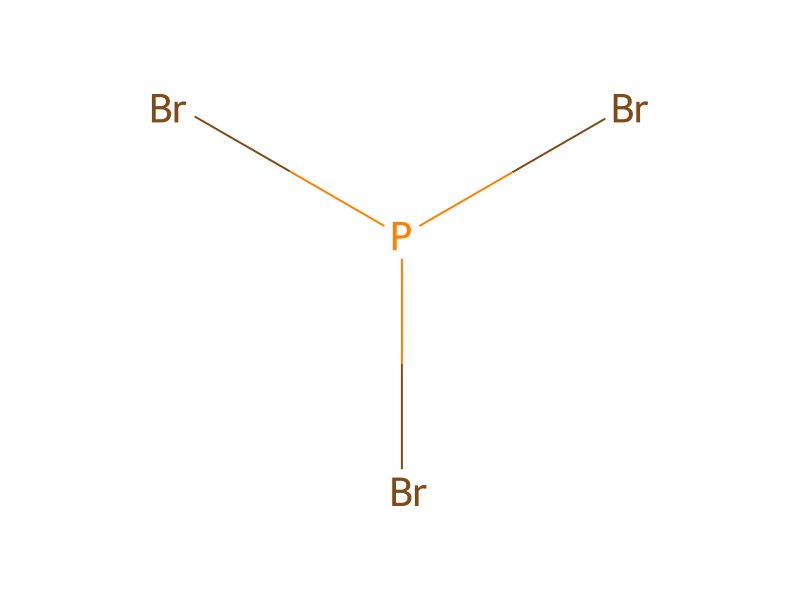
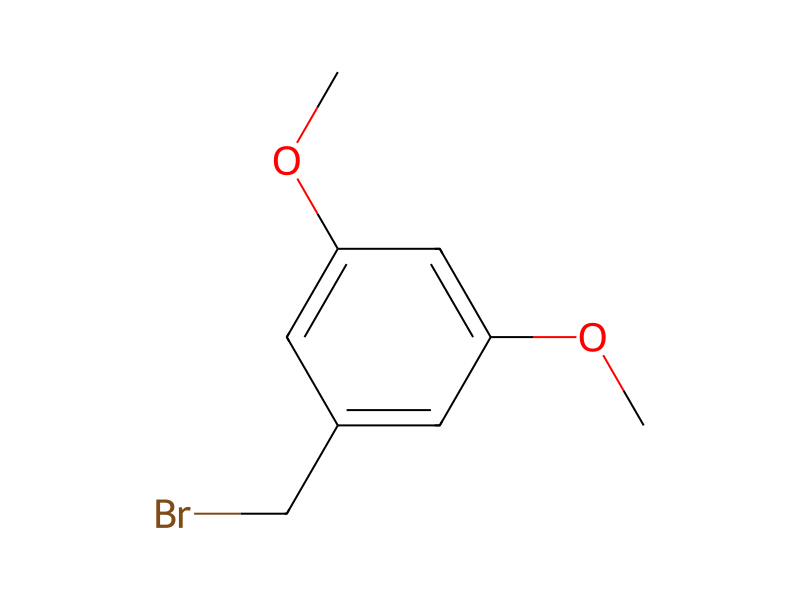
P(Br)(Br)Br.[Br-].[CH3:6][O:7][C:8]1[CH:9]=[C:10]([CH:13]=[C:14]([O:16][CH3:17])[CH:15]=1)[CH2:11]Br.[C:18]([Si:20]([CH3:23])([CH3:22])[CH3:21])#[CH:19]>ClCCl>[CH3:6][O:7][C:8]1[CH:9]=[C:10]([CH2:11][C:19]#[C:18][Si:20]([CH3:23])([CH3:22])[CH3:21])[CH:13]=[C:14]([O:16][CH3:17])[CH:15]=1Participants
Reactant 4


Product 1

Reagents, catalysts & solvents 1

Procedure
The 3,5-methoxybenzoic acid is converted to (E)-5-(2-halo-3-iodoallyl)-1,3-phenylene bis(2,2-dimethylpropanoate) by first reducing the 3,5-methoxybenzoic acid to produce 3,5-dimethoxybenzyl alcohol. Suitable reducing agents include metal hydrides such as lithium aluminum hydride. In one embodiment, the reduction is performed in tetrahydrofuran; the reaction is initiated at 0° C., then allowed to warm to room temperature and proceed for 5 hours. The alcohol then is brominated to produce 3,5-dimethoxybenzyl bromide. Suitable bromination reagents include phosphorus tribromide. In one embodiment, bromination is performed with PBr3 in dichloromethane; the reaction is initiated at 0° C., then allowed to warm to room temperature and proceed for 3 hours. The bromide is replaced with an alkynyl group by the 3,5-dimethoxybenzyl bromide by reacting with ethynyl trimethylsilane to form (3-(3,5-dimethoxyphenyl)prop-1-ynyl)trimethylsilane. In one embodiment, the reaction is performed by first combining ethynyl trimethylsilane and ethylmagnesium bromide in tetrahydrofuran; after 30 minutes at room temperature, copper (I) bromide is added, followed by the 3,5-dimethoxybenzyl bromide, and the reaction is allowed to proceed at reflux for 20 hours. Next, the (3-(3,5-dimethoxyphenyl)prop-1-ynyl)trimethylsilane is desilylated to produce 1,3-dimethoxy-5-(prop-2-ynyl)benzene. Suitable desilylating reagents include tetrabutylammonium fluoride. In one embodiment, the reaction is performed with tetrabutylammonium fluoride in tetrahydrofuran/acetic acid at room temperature for 25 hours. The methoxy groups are then protected by addition of protecting groups to produce 5-(prop-2-ynyl)-1,3-phenylene bis(2,2-dimethylpropanoate). In one embodiment, the protecting groups are pivaloyl groups added by reacting the 1,3-dimethoxy-5-(prop-2-ynyl)benzene with boron tribromide, followed by pivaloyl chloride. Specifically, the 1,3-dimethoxy-5-(prop-2-ynyl)benzene is reacted with BBr3 in dichloromethane; the reaction is initiated at 0° C., allowed to proceed at room temperature for 16 hours, and then quenched with sodium bicarbonate. The resulting product is dried, dissolved in dichloromethane and triethylamine, and reacted with pivaloyl chloride at room temperature for 1.5 hours. Finally, the 5-(prop-2-ynyl)-1,3-phenylene bis(2,2-dimethylpropanoate) is halogenated to produce (E)-5-(2-halo-3-iodoallyl)-1,3-phenylene bis(2,2-dimethylpropanoate), wherein the halogen corresponds to R4 in the chrysophaentin. In one embodiment, a 2-chloro compound is formed by reacting the starting material with iodine monochloride in dichloromethane; the reaction is initiated at 0° C., then allowed to warm to room temperature and proceed for 3 hours.
Workup
- customis initiated at 0° C.
Sources & evidence
- ORD record
- ord-3c9176bf724848db8412f10368bc12c0
- Source dataset
- uspto-grants-2015_10
- Patent number
- US09169182B2
Reaction notes
Loading…